Food Systems Sustainability Financing: A Responsibility For All
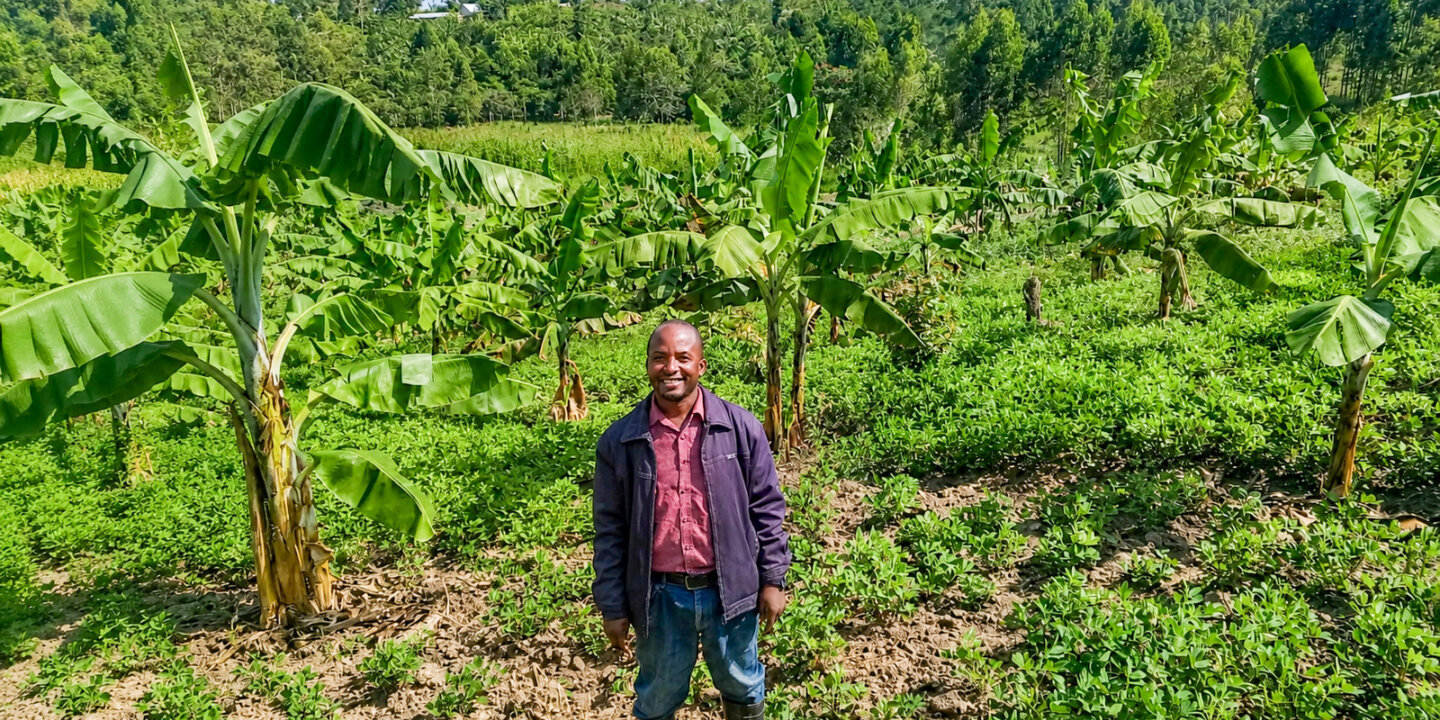
Dan at his small demonstration farm in Kasanda District, Uganda, which he plans to develop into a sustainable food systems model for learning and community empowerment. Picture taken on 5 July 2025.
Dan Kayita is Manager, Agriculture Finance at Finance Trust Bank, Uganda, and an agricultural finance and credit risk expert with over 14 years of experience in agribusiness finance and value chain development. As a participant in the 2026 Food Systems Finance e-course, he reflects on how adopting a food systems perspective has reshaped his approach to sustainable agricultural finance.
A few weeks ago, I found myself reaching out to two international impact funders and bringing together agricultural production SACCOs, produce traders, and processors to discuss sustainable food systems finance. Looking back, I realised these were not initiatives I would have approached in the same way before participating in the Food Systems Finance e-course.
Although I have spent the better part of the last 15 years promoting financial inclusion for agribusiness actors across diverse agricultural value chains, never had I been challenged to adopt such a broad food systems perspective. I had always focused on improving access to finance, but I now see that finance has an even greater role to play, not only in ensuring sufficient food for humanity but also in safeguarding our planet.
Personally, I adopted a fundamentally new perspective: a food systems approach to interventions undertaken both within my organisation and in collaboration with other food systems actors. This enabled me to move beyond understanding the dynamics of agro-food value chains to recognising that sustainable and inclusive food systems are essential to addressing many of today’s global challenges, including famine, malnutrition, environmental degradation, unemployment, and poor health conditions.
I also came to appreciate that, from the smallest ecosystem to the global one, every actor and every activity has either a positive or a negative impact on the wider food system. This strengthened my conviction that we need stronger synergies among food system actors, financing approaches that accommodate these complex interactions, and better ways of measuring and monitoring their impact.
Food systems transformation cannot be achieved without coordinated contributions from diverse actors. Because food systems are interconnected across sectors and geographies, financing interventions and impact assessments must also be more integrated to generate more meaningful evidence for effective planning and implementation.
This new perspective has inspired me to play a more active role in advancing food systems transformation through sustainable financing. I have started raising awareness within my institution and reached out to two international impact funders to explore opportunities for advancing sustainable food systems finance. One has already scheduled an inception engagement meeting. The goal is to explore a blended finance initiative for my organisation with an international impact funder. The proposed model would provide guarantees to lenders supporting institutions like mine, while also offering portfolio guarantees and capacity building for organisations investing in environmental conservation and biodiversity.
Beyond my professional role, I have started developing a small farm as a practical model for sustainable food systems, where I hope to demonstrate approaches that can inspire and empower others.
As part of these efforts, I organised two food systems actors’ symposiums, one for agricultural production SACCOs and another for produce traders and processors. During both events, I delivered presentations on ecosystem sustainability and food systems finance.
These experiences have further convinced me that food systems sustainability financing requires commitment from financial institutions, governments, development partners, farmers, businesses, and consumers alike. Only through coordinated action can we build food systems that are resilient, inclusive, and environmentally sustainable. To me, that is what makes food systems sustainability financing a responsibility for all.
Author

Dan Kayita
Food System Finance e-course 2nd Cohort