Beyond Market Linkage: An Ecosystem Approach for Farmer Producer Organizations
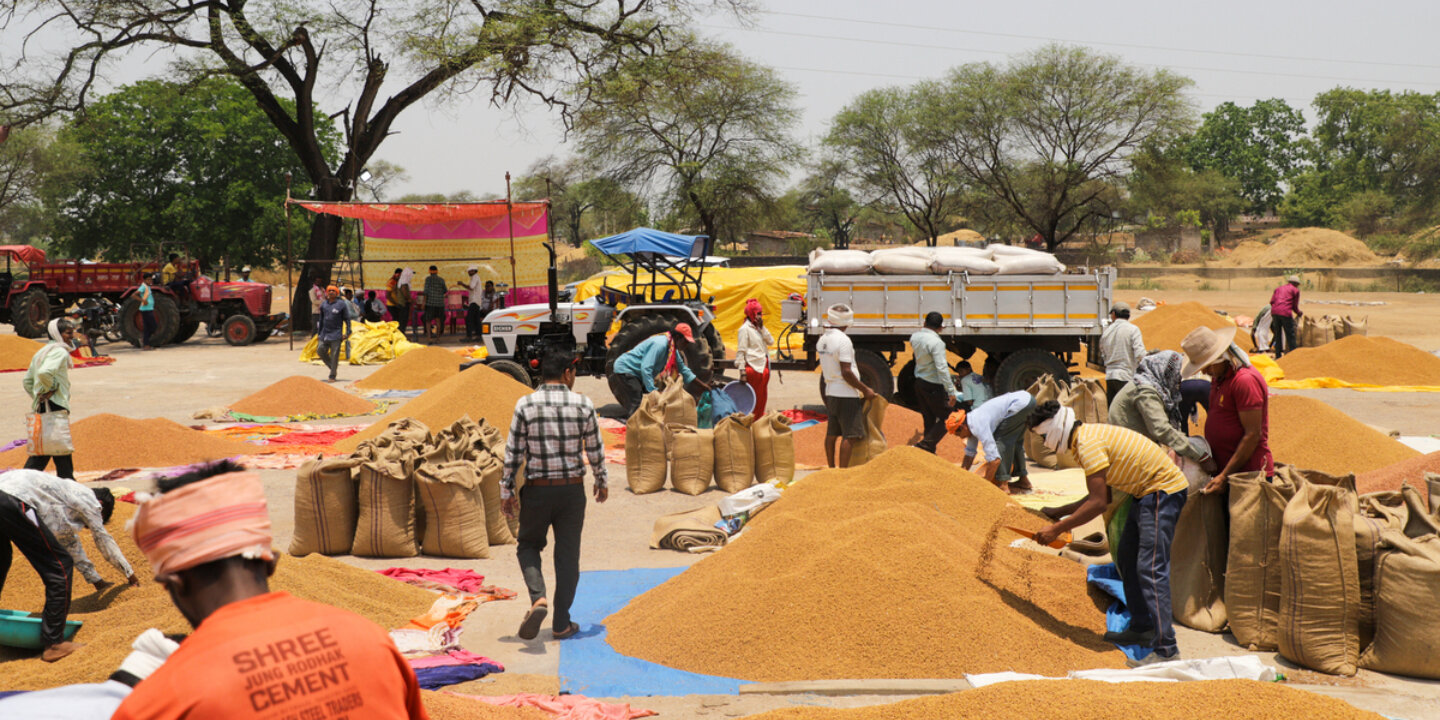
Farmers sorting, quality checking, and packaging Raipur, Chattisgarh. Picture by Anway Sarkar, May 2025.
Avijeet Kumar is SBU Head, Financial Inclusion Consulting at BASICS Ltd. (BASIX), India, with over 15 years of experience advancing rural livelihoods through inclusive financial ecosystems. As a participant in the 2026 Food Systems Finance e-course, he reflects on how the BASIX Farmers Market ecosystem approach demonstrates food systems finance in practice, helping Farmer Producer Organizations achieve long-term commercial sustainability.
India has successfully created more than 10,000 Farmer Producer Organizations (FPOs), but the real challenge is not their formation but their commercial sustainability.
Identifying buyers is only one part of the problem. Many FPOs collapse because they lack the working capital to hold produce until the right buyer is found. FPOs also need to aggregate produce at scale, ensure quality standards, manage logistics, access working capital, and receive timely payments. Without these elements, they remain dependent on local traders and are unable to realize better prices for their members. Building sustainable market relationships supported by appropriate financing is therefore the next frontier for Indian FPOs.
In my fifteen years of working in banking and financial inclusion with BASIX, I have seen the journey of thousands of smallholder farmers and rural enterprises. Participating in the Food Systems Finance e-course helped me connect this practical experience with broader food systems finance concepts. It reinforced that sustainable food systems require financing models that support entire value chains rather than isolated transactions. Looking back, I realised that many of these principles had already been guiding our work at BASIX.
BASIX has promoted more than 1,000 FPOs, benefiting nearly one million farmers and their households across India. Creating farmer institutions is only the first step; ensuring their commercial sustainability is the real challenge.
Over the years, we realised that market linkages cannot work in bits and pieces. Farmers need an integrated ecosystem that brings finance, markets, and support services. Together with multiple partners, BASIX has developed the BASICS Farmers Market model. During the pilot phase, VAMCOM provided working capital support, while LDC supported invoice discounting. We provide quality inputs to farmers, register them through a digital platform, identify institutional buyers, and procure their produce with payments made within one business day (T+1). The produce undergoes quality testing and is stored in warehouses before reaching buyers. Short-term capital and invoice discounting support the transactions, reducing risk for all stakeholders. The model ensures better prices for farmers, timely payments, quality produce for buyers, and a commercially viable financing ecosystem.
This model goes beyond financing an individual farmer or a single transaction. It connects farmers, FPOs, input suppliers, quality testing agencies, warehouses, financiers, and buyers into one ecosystem. Every stakeholder has a role, and every transaction is supported by information, quality assurance, and timely finance. As the e-course highlighted, finance is most transformative when it strengthens relationships across food systems rather than supporting isolated actors. The result is better prices for farmers, lower risk for financiers, and reliable supply for buyers.
The future of agricultural finance lies in financing relationships, information flows, and value chains, not just individual loans. Only then can FPOs become commercially sustainable and smallholder farmers become active participants in decision making within resilient food systems.
Since its launch in November 2024, the integrated model has facilitated transactions worth approximately ₹15.7 crore (around US$1.83 million), covering nearly 47,500 quintals of agricultural commodities, including maize, wheat, onion, pigeon pea (toor), and black gram. This experience demonstrates that ecosystem-based food systems finance is not merely theoretical, but a commercially viable approach. I believe this approach can be replicated across India and in many other agricultural contexts.
Author

Avijeet Kumar
Food System Finance e-course 2nd Cohort