Studying Vulnerability While Living It: Lessons from Venezuela’s Fish Food System
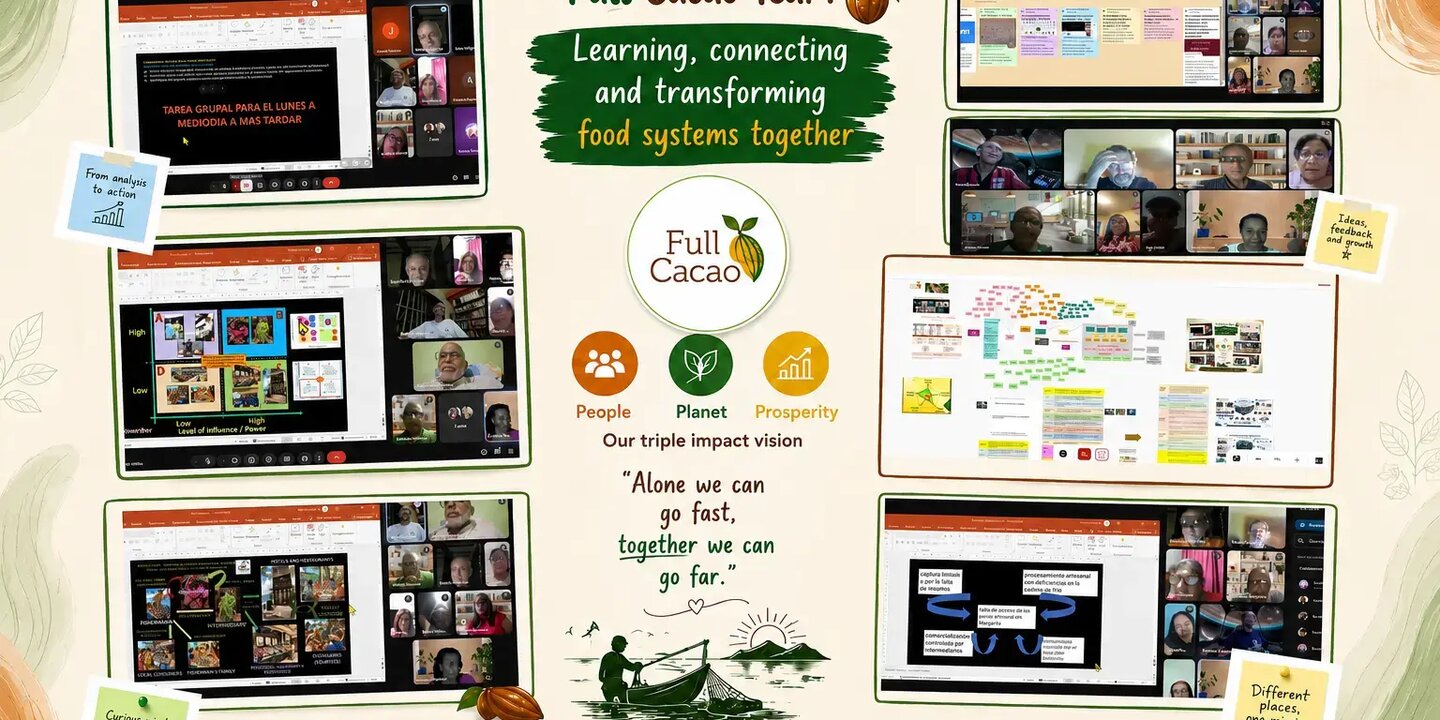
Members of the Full Cacao Team participated in the Food Systems in Practice training and worked on their case entirely virtually, as they are located across different regions of Venezuela and two team members in the United States.
As one of the nine teams that joined the Food Systems in Practice training, the Full Cacao team from Venezuela explored vulnerabilities within the country’s artisanal fisheries system. Their blog reflects on a powerful realization: while studying vulnerability in food systems, they were also experiencing it themselves. Through systems thinking, they uncovered deeper patterns, hidden costs, and opportunities for transformation.
By Full Cacao C.A Team
“Here we are, studying the food system without giving up…” Mario said during one of our sessions. Some laughed and others sighed because that phrase captured what we were experiencing as a team and discovering through Venezuelan fisheries.
At the beginning, we thought we were going to study a value chain: fishers, fish, markets, consumers, infrastructure, and institutions. But the more we investigated, the more we understood that the case reflected something deeper: we were not only studying vulnerability; we were experiencing it.
It seemed as if we were moving through two dimensions: one as researchers, searching for data and analysing, and another, experiencing the vulnerabilities of artisanal fishing. Some teammates in Venezuela faced power outages and political uncertainty. Those of us outside the country faced other difficulties while witnessing their challenges. Little by little, vulnerability stopped being just a course concept. It became part of our working conditions.
However, our ambition has always been clear: from Full Cacao, a Venezuelan applied research and development company, we seek to transform the Venezuelan food system toward one that is more regenerative, sustainable, and evidence-based. Although our organization was born from and linked to cacao, this formative, collaborative, and systems-reflection process allowed us to broaden our view toward other vulnerable but strategic food systems, such as artisanal fishing. As a multidisciplinary team, we believe food systems can be transformed through accurate information, technology, management, and a human-centred approach.
Venezuela, framed by the Caribbean Sea, has significant marine production potential. However, that potential does not always translate into better livelihoods for fishers or greater food security for communities. On Margarita Island, the gap between what the sea can offer and what the system allows people to benefit from became evident. For that reason, our case focused on a systemic failure within the artisanal fishing value chain.
At first, we tried to organize the case through a rich picture. It forced us to ask: Where does the problem really begin? In the boat? In the cold chain? In the lack of fuel? Or in the lack of reliable data?
The answer was uncomfortable: it was not in just one place. It was in the connections.
A fisher may catch fish, but without ice, electricity, transportation, fair prices, and reliable markets, that fish can lose value before reaching the consumer. What appears to be a production problem can also be a problem of infrastructure, governance, nutrition, and social justice.
Then came the discussions about the actors in the system, and the team’s diversity became important. Ramón brought discipline and urgency; Mónica supported the idea; Dorkis managed technology, logistics, and translations; Mario and Benito encouraged reflection; and Janeth, Ahimara, Roraima, Eyda, Andrés, Antonio, and Rina contributed organization, information, data, and perspectives. Together, these contributions consolidated the team.
This was not a perfect process; it was a real process. And precisely for that reason, one question from Ramón marked a before and after: “Did you realize it? We are analysing the vulnerability of the fishing system, but we ourselves were also part of that vulnerability.”
That moment changed the way we understood the case.
The food system map helped us move from isolated problems to systemic patterns. We noticed how weak infrastructure increases food loss, how lack of information limits decision-making, how low incomes push communities toward survival strategies, and how repeated resilience can become an invisible burden. This process made visible the hidden externalities and costs represented by the fisher’s exhaustion.
That was one of our most important lessons: resilience should not be idealized.
It is heroic that fishers continue working despite uncertainty. It is powerful that our team continues learning despite barriers, but resilience has a cost. When people must constantly adapt to broken systems, they are paying hidden human and social costs. The Venezuelan artisanal fisher, in the effort and necessity of resilience, is exhausting precarious work, damaging health, altering the ecosystem, and doing so at the expense of future generations, with ecological and social impact.
This understanding helped us redefine the case. Among many reflective virtual conversations and critiques, the question was no longer only: How can we improve the fishing value chain? The question became: How can we design a system where people do not have to be heroic just to make it work?
From that perspective, the leverage points became clearer: better data makes hidden problems visible, cold chain infrastructure protects income, nutrition, and dignity, and training new actors marks the beginning of a new food systems culture. True Cost Accounting helps reveal the cost of waste, informality, deficient infrastructure, and human exhaustion.
As a team, we learned that transformation begins before the solution. It begins when people learn to look at the same problem together.
This work consolidated us as a team, turning differences into strengths. Our next step is to continue developing a vision for a regenerative and sustainable Venezuelan food system, connecting technology, data, and human realities. We want to work with fishing communities, educational institutions, and local actors to design a training and support model that helps fishers break cycles of dependency, strengthen entrepreneurial capacities, diversify economic opportunities, and participate with greater autonomy in market decisions, including negotiating fairer prices for their work.
The Venezuelan fish food system taught us something lasting: vulnerability is not only measured in statistics; it also appears in a missed team meeting or in a fisher who works hard but still cannot capture the true value of their effort.
And if resilience has a cost, then transformation must reduce that cost.
Perhaps that is our most important lesson: a sustainable food system is not one where people simply endure more. It is one where people can finally stop surviving the system and begin transforming it together.
At the end of this journey, we asked ourselves one question: if we had to summarize this group experience in one word, what would it be?
Transformation, Resilience, Courage, Commitment, Restoration, Perseverance, Renewal, and Revitalization.
Authors

Monica Chirinos

Ramón Lameda
2026 Food Systems e-course Participant
Benito Diaz Diaz

Andrés Marcano

Janett Fermin

Ahimara Suarez

Rina Rivera

Roraima Hernandez
Dorkis Shephard

Eyda Ovalles