When the Map Changes Everything: Our Food Systems Journey
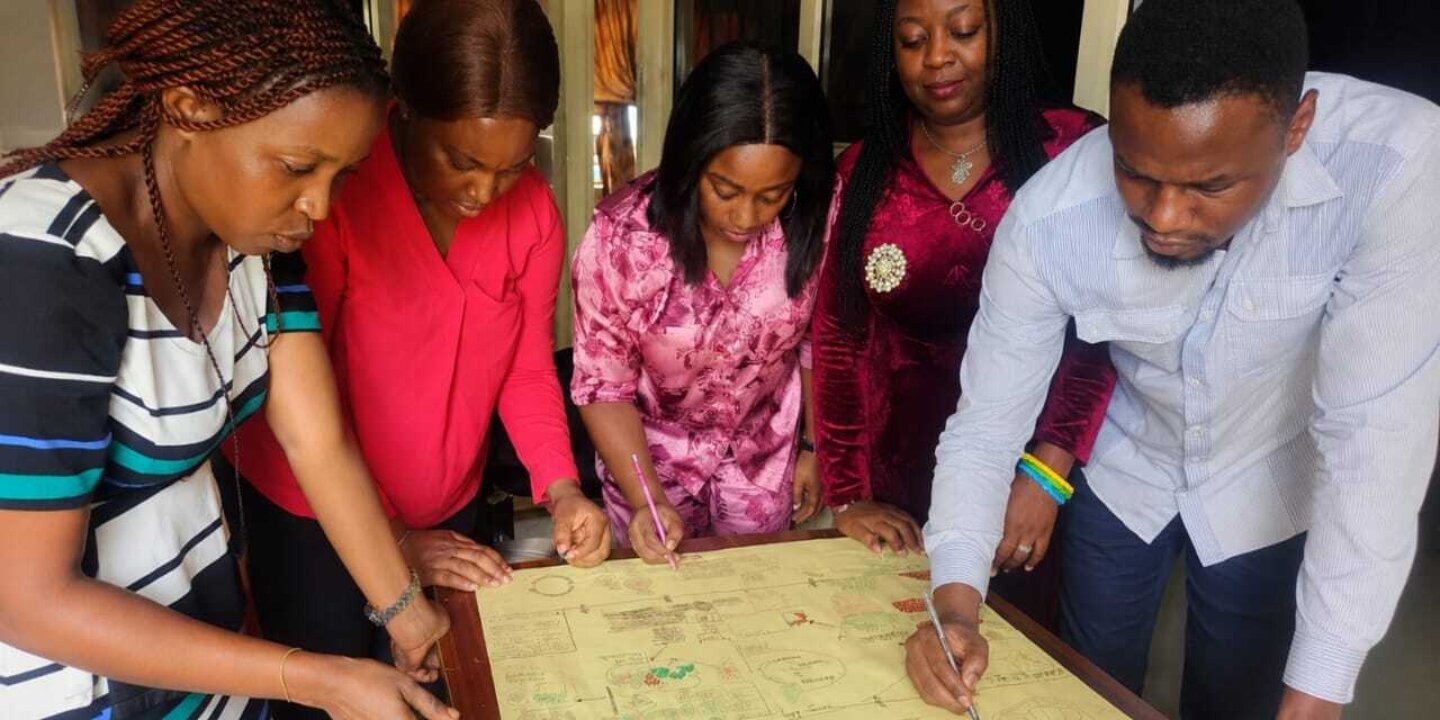
A key moment in our learning process, where we translated ideas and insights into a rich picture that revealed the relationships and dynamics within the food systems.
The Nigerian Stored Products Research Institute (NSPRI) team joined the 2026 Food Systems in Practice training alongside nine other teams from around the world, exploring the persistent challenge of postharvest losses in tomatoes and leafy vegetables in Kwara State, Nigeria. Their blog reflects on a key shift in thinking, from viewing food loss as a technical problem to understanding it as a broader food systems challenge shaped by markets, governance, infrastructure, and stakeholder relationships.
By Nigerian Stored Products Research Institute (NSPRI) Team
There was a question we could not stop asking ourselves during the training. We had spent years working on postharvest losses in tomatoes and leafy vegetables at the Nigerian Stored Products Research Institute (NSPRI), Ilorin. We developed storage technologies, organised training for farmers and communities, and researched produce deterioration. Yet despite these efforts, farmers in Kwara State were still losing 40 per cent of their harvest every season.
NSPRI’s mandate is to develop and promote effective postharvest management technologies, alongside postharvest research, engineering, and extension. Reducing postharvest losses contributes directly to improved food security and livelihoods across. We selected Kwara State because team members are based there, allowing us to ground our analysis and interventions within our immediate operational context.
During the Food Systems in Practice training, one simple question changed the direction of our thinking: if solutions already exist, why are losses still happening? That question led us into many others. Why do these losses continue year after year? Who benefits from the present arrangement? Who is excluded? Why do good technologies sometimes fail even when they are available?
These questions became the thread running through our entire experience on the food system in practice training. And the answer, we slowly discovered, had very little to do with storage technology. That shift from “fixing problems” to “understanding systems” became the biggest lesson of the course.
From Fixing Problems to Understanding Systems
The practical training asked us to map our food system. Not just the value chain, but the drivers shaping it, the actors operating within it, the connections between them and the feedback loops quietly reinforcing the problems we were trying to solve.
Another surprise emerged when we examined the processing node! When we drew the arrows, we realised that tomato paste businesses and vegetable drying enterprises in Kwara State are almost completely disconnected from the smallholder farmers who grow the produce they need. During peak harvest, when prices collapse and farmers are forced to sell at a loss, processors could absorb the surplus and convert it into shelf-stable products. But no formal linkage exists to make that happen. We had been designing storage solutions for a system that was missing a buffer that was already there.
An interesting highlight of the training was realizing that food systems are not only about production. They are also about governance, culture, transport, gender, markets, power, climate, consumer behavior, and even trust. Suddenly, the tomato sitting in a market stall was no longer just a tomato. It became connected to roads, electricity, market information, women traders, fuel prices, storage access, and national policy decisions.
The Debates That Changed Our Perspectives
As a team, we framed our main problem simply as “lack of storage.” Then came the stakeholder analysis; placing actors on a matrix of influence and interest sounded straightforward, but it created some of the sharpest debates our team has had in years. Should we place large supermarket chains in the low-interest quadrant, as we initially did, because they play a limited direct role in Kwara State's informal fresh produce markets? Should we place the large aggregators, the “alaros” known as the middlemen down here, in the high influence quadrant? Formally, they hold no official power, but they control pricing at the farm gate, decide which farmers get access to market transport, and can block a new information system simply by refusing to participate.
We went back and forth on this more than once. Trang, our course facilitator, asked us to explain our reasoning rather than simply accepting our first answer. We spent hours on these questions, and discovered that the issues were much more complex. Coordinating across our different views was not always easy, but it was always worthwhile. We came out of each mapping session with a sharper, more honest picture of the system than any of us had walked in with.
One of our biggest lessons was learning how to navigate different perspectives. Members brought expertise from research, extension, technology development, and stakeholder engagement. While this occasionally resulted in lengthy debates, it ultimately strengthened our analysis.
Concepts like trade-offs, resilience, governance, and leverage points that initially sounded abstract became very practical over time and gradually became tools for thinking differently. With trade-offs, we learned that solving one problem could sometimes create another. For instance, introducing cold storage facilities may reduce food losses, but it may also increase produce prices and energy costs, especially to small-scale farmers and traders. These conversations helped us appreciate why food systems transformation is rarely straightforward.
The networking aspect of the e-course was equally valuable. Beyond lectures and assignments, the platform created room for dialogue, reflection, and collaboration. We exchanged ideas with professionals from research institutes, NGOs, universities, and government agencies across different countries. Discussions on governance, biodiversity, informal markets, financing, nutrition, and postharvest innovations enriched our learning by connecting theory to lived experiences.
And then we had to redefine our case after several weeks of learning, unlearning and relearning. We discovered how important leverage points were. We also learned that choosing the right entry point is not only what matters most, but also about what is possible. Hence, we had to focus our final strategy on two leverage points: strengthened postharvest handling and storage infrastructure, and a transparent market information system. Neither of these was the deepest point in the system, governance reform sat deeper, but these were the places where NSPRI and our existing partnerships felt would give us the most realistic chance of creating visible, measurable change within three to five years.

Image: Engaging in discussions during our final presentation, where months of learning and collaborative efforts came together.
Looking Ahead
The most important outcome for us as a team is that we no longer see postharvest loss as merely a technical issue. We now see it as a food systems issue that requires coordinated solutions involving infrastructure, governance, market transparency, stakeholder inclusion, and behaviour change. We leave the training with a clearer picture of the food system and a better sense of where NSPRI's contribution fits within broader efforts to reduce postharvest losses in Kwara State. We are committed to carrying these lessons into our research design, community engagement, and our policy advocacy work.
For NSPRI, these lessons will inform stronger engagement with farmers, processors, market actors, and policy makers, while guiding future programmes towards interventions that address root causes and strengthen system-wide collaborations.
The tomatoes are still spoiling between the farm and the fork. But we now have a much better map of why, and a clearer sense of where to start. The biggest lesson we take back with us from Food Systems in Practice is that food systems are not transformed by isolated interventions, but by connected people, connected ideas, and connected actions.
Authors

Eunice Bamishaiye

Tobi Olasope

Titilope Fashanu

Akudo Onyegbula

Israel Lawal

Blessing Adediran

Kehinde Atilola