Looking Beyond the Plate: Rethinking Nutrition Through Food Systems in Practice
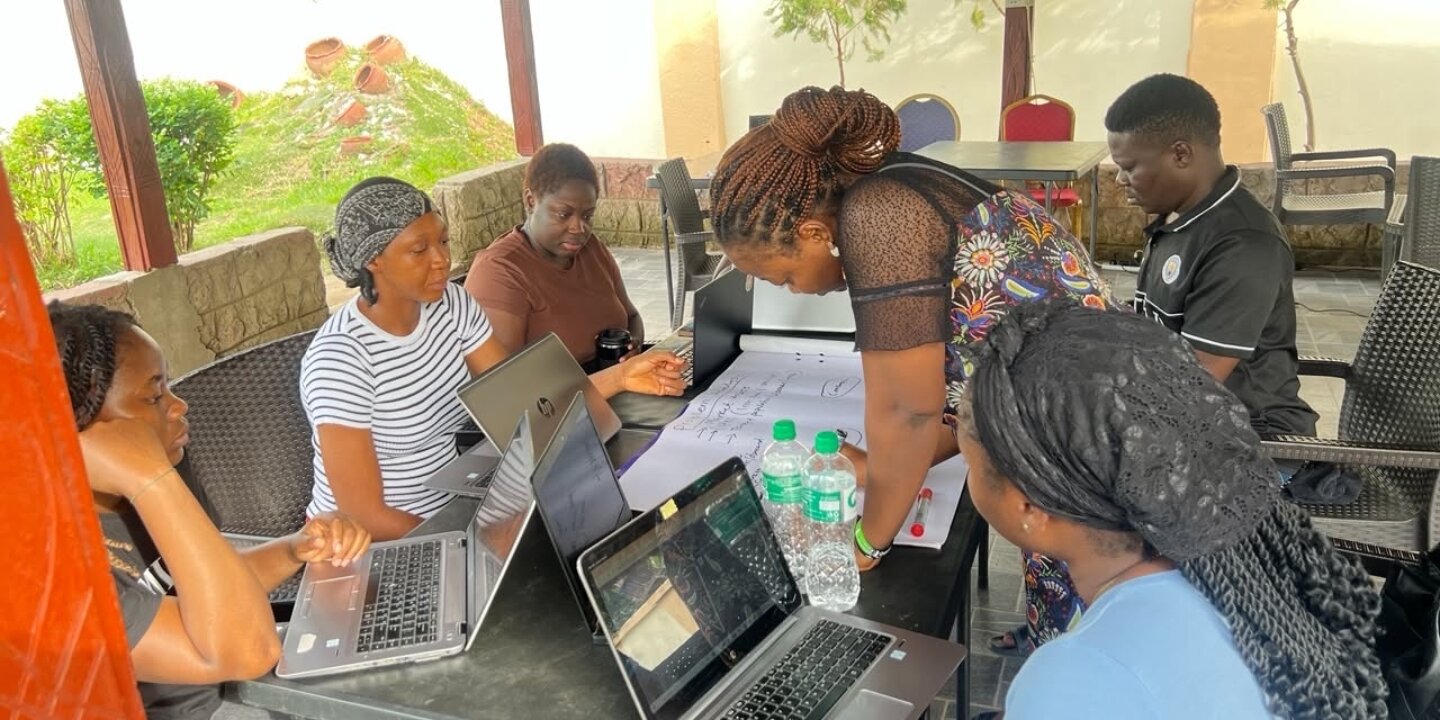
Team members of ChananHill Social Enterprise analysing their case and mapping stakeholders during the Food Systems in Practice training.
ChananHill Social Enterprise joined the 2026 Food Systems in Practice training alongside nine other teams, exploring how limited market access for women and youth farmers affects nutrition and livelihoods in Northern Nigeria. Their blog reflects on a key lesson from the practical training: improving nutrition requires more than education alone, it requires food systems that make healthy choices available, affordable, and desirable.
By ChananHill Social Enterprise Team
At ChananHill Social Enterprise, we work to improve nutrition and livelihoods among women and households in Nigeria. Through initiatives such as the Balanced Plate Project, we have seen how nutrition education can help families make healthier food choices.
When our team joined the Food Systems in Practice training, we selected a case study on limited market access for women and youth farmers in the iron pearl millet value chain in Northern Nigeria. We chose this challenge because it sits at the intersection of nutrition, livelihoods, and inclusive food systems, all of which are central to our work.
At the beginning of the practical training, we viewed the issue mainly through a nutrition lens. We believed that if people understood the value of nutritious foods and farmers received adequate support, healthier diets and better livelihoods would naturally follow.
However, the food systems tools used throughout the e-course challenged that assumption.
Through stakeholder mapping, we discovered that women and youth farmers, those most affected by poor market access, often have the least influence over market decisions. Meanwhile, processors, regulators, development organizations, and retailers play a significant role in shaping opportunities within the value chain.
Our food systems mapping exercise revealed an even bigger insight. The challenge was not simply about production. Low consumer demand for millet products discourages processors from investing in new products. Limited product innovation reduces consumer interest and market visibility, which further weakens demand. These interconnected dynamics create a cycle that limits opportunities for farmers and slows commercialization.
This shifted our understanding of the relationship between nutrition and the wider food systems.
We reflected on our own experiences promoting balanced diets. We have often observed that nutrition education alone does not always lead to healthier eating. Once families understand what a healthy diet looks like, affordability and access quickly become important concerns.
Yet many nutritious foods are already available within local communities. Vegetables such as okra and ugwu, traditional grains such as iron pearl millet and fonio, orange-fleshed sweet potato, and Tom Brown porridge all offer affordable and nutritious options for households.
The Food Systems in Practice training helped us recognize that healthy diets are influenced by much more than knowledge. They depend on what farmers produce, what processors develop, what retailers sell, and what households can access and afford.
As a team, one of our biggest lessons was the importance of looking beyond individual interventions to understand the wider system. Different perspectives within our group helped us see how nutrition, markets, policy, innovation, and consumer behavior are interconnected. Working through the food systems tools together also challenged us to question our own assumptions, listen to one another, and build a shared understanding before identifying solutions.
Based on our analysis, we identified two key leverage points for change: increasing consumer awareness and demand for millet products and supporting processor-led product innovation. Together, these interventions can strengthen markets for farmers while making nutritious foods more attractive and accessible to consumers.
For ChananHill, this learning journey reinforced an important message: improving nutrition requires more than education alone. It requires food systems that make healthy choices available, affordable, and desirable.
As we continue our work, we hope to apply these lessons by promoting nutritious local foods, supporting nutrition-sensitive value chains, and building partnerships that connect farmers, processors, and consumers. These lessons will also continue to shape how we design programmes, engage stakeholders, and strengthen inclusive food systems that benefit women, youth, and rural communities.
The Food Systems in Practice training reminded us that healthier diets begin long before food reaches the plate. They begin with the systems that shape how food is produced, processed, marketed, and consumed.
Authors

Alexandra Anebor

Hembafan Ngutor

Favour Jauro

Chinaza Ike

Esther Yila