Milking Hope: Every Drop Tells a Story of Dairy Farming in Runyenjes
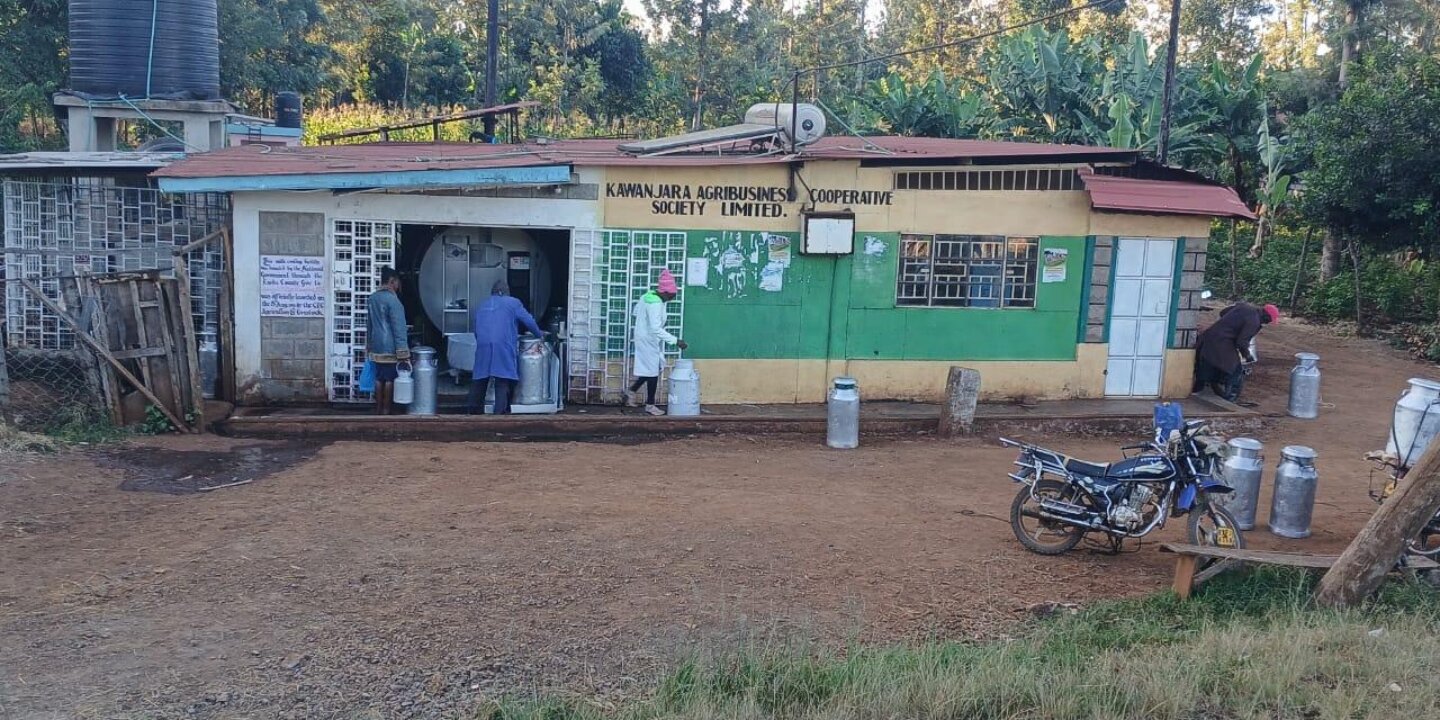
Premises of Kawanjara Commercial and Agribusiness Cooperative Society, aggregating the milk delivered by farmers. Picture taken on 29 December 2025, by Susan Mumbi.
Susan Mumbi Gicheha is an Agribusiness Advisor at Equity Bank Kenya, working closely with smallholder farmers in Embu County. A participant of the Food System Finance e-course, she draws on her first-hand experience to reflect on how blended finance can turn everyday hope into tangible reality for dairy farmers in Runyenjes.
Every dawn is a day of hope in Runyenjes Constituency, Embu County, Kenya. For many families, the day begins the same way: farmers wake early, warm milking water, and walk into a small cowshed behind the homestead, carrying a bucket and hoping that today’s milk will be enough for household needs. Here, dairy farming is more than an activity. It is a lifeline.
Through my work, I engage closely with dairy farmers whose livelihoods depend on a few cows and the daily flow of milk. A typical dairy farmer keeps one to three dairy animals, with an average daily production ranging from 7 to 16 litres per cow. Across Runyenjes, cooperatives such as Kawanjara, Kathande, Mkulima Bora, Kanja, and others collect and market milk. Each day, farmers deliver milk hoping their hard work will translate into good returns.
Behind this promise lies a daily struggle. Animal feed is expensive and not always available. Cooling facilities are also inadequate, leading to poor milk quality, rejections, or low prices. Improved dairy breeds remain out of reach for many farmers, while veterinary services are costly and, in many occasions, unreliable. Insurance is still poorly understood, leaving farmers exposed to loss. For many families, dairy farming has been a cycle of effort without meaningful progress.
Yet, hope continues to flow quietly through the cans of milk delivered to cooperatives. Sadly, the cooperatives themselves face serious constraints. Electricity bills can reach as high as KES 200,000 per month, increasing operational costs which are then transferred back to the farmers through lower milk prices. At the same time, access to credit is beyond reach due to weak banking history, unstable income, and recurring losses.
In light of these challenges, blended finance offers a turning point for dairy farmers in Runyenjes and beyond. By combining public, philanthropic, and private capital, blended finance reduces risk and opens doors to affordable credit. This makes it possible for cooperatives to invest in milk cooling plants, feed processing and supply systems, value addition, and farmer training.
In my work at Equity Bank, I have seen how this approach functions in practice. In Embu County, public investment has helped cooperatives access milk cooling equipment, often through grants. What is often missing is the financing that allows these cooperatives to operate sustainably. By combining public support with commercial lending, private funds have supported cooperatives to acquire land, access working capital, and pay farmers on time, even when milk buyers delay payments. Digital credit and payment solutions have further strengthened operations, enabling farmers to access quality feeds, improve breeds and fodder production, and rely on more consistent animal health services.
Similar blended approaches in the wider Mount Kenya region, such as irrigation financing that combines grants, patient loans, and market linkages, show how aligning finance with production realities can transform livelihoods over time.
For farmers, this means accessing quality feeds, loans to purchase better cows and increase fodder production, and more reliable animal health services. The end result is increased milk volumes and improved milk quality, leading to more stable incomes, thus slowly changing dairy farming from survival to profitable venture.
In dairy farming, the impact goes far beyond milk. When cooling, timely payments, and access to finance come together, dairy farming begins to shift from survival to viable business. Better earnings improve household nutrition, help families afford school fees, and enable reinvestment in other enterprises. With the right blend of finance, dairy farming holds cooperative strength and knowledge — a promise of transformation and a shared reality of hope.
—
Disclaimer: The views and opinions expressed in this blog are solely those of the author and do not necessarily reflect the views, policies, or positions of any organisation with which the author is currently or has previously been affiliated.
Author

Susan Mumbi Gicheha
Food Systems Finance e-course Cohort