Blending Finance to Unlock Sustainable Food Systems in Rangelands
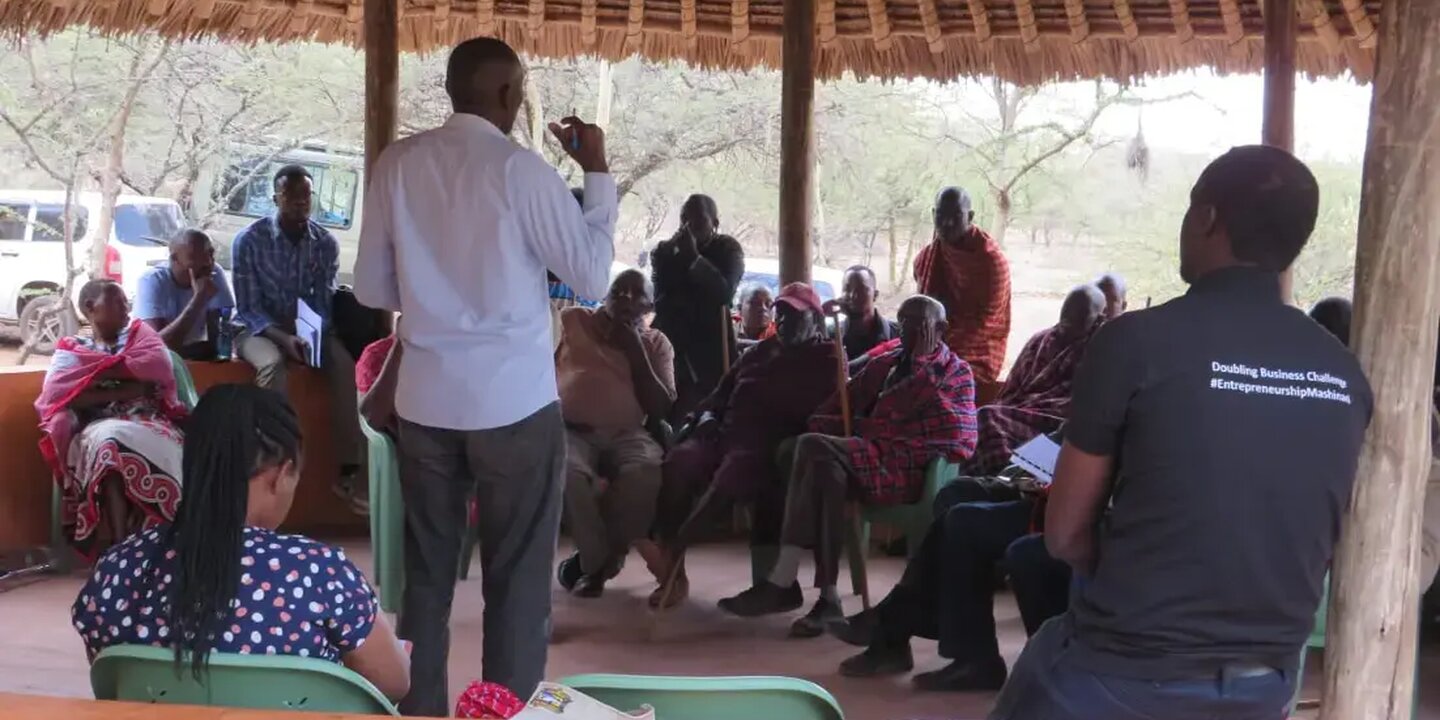
Community consultation meeting at Empaash Oolorienito Conservancy on Priority Agribusiness Value Chains and Implementation Planning, 5 February 2026. Mr. John Letoya, Chairman of the conservancy, is speaking in the middle, and I am sitting on the right. Picture taken by Jessica, one of the conservancy scouts.
Jeremy Riro is Managing Partner at Fie-Consult and General Partner at Unseen Capital, Kenya. As a participant in the 2026 Food Systems Finance e-course, he reflects on how blended finance can unlock sustainable agribusiness investments, strengthen community resilience, and reduce donor dependency in Africa’s rangeland food systems.
When we first visited Empaash Oolorienito Conservancy in Kajiado County, Kenya, in 2025, we encountered a familiar challenge. Like many rangeland communities across Africa, there were only a few isolated donor-funded projects with short lifespans, leaving the community food insecure and vulnerable. This experience reflects a much broader challenge.
In Africa, more than 300 million agro-pastoralists derive their livelihoods from rangelands, while contributing up to 50% of agricultural gross domestic product (GDP) in individual countries in the Horn of Africa. Yet, due to the climate risks that arid and semi-arid lands (ASALs) are exposed to, commercial capital has not traditionally been deployed in these areas at scale.
This has resulted in grant dependency and short-term food security interventions that do not create lasting solutions to transform rangelands into sustainable food ecosystems.
During our site visit together with ADA (Appui au développement autonome), with whom we are implementing an environmental restoration and conservation project, we realised that integrating livelihood initiatives into the project was critical.
Our firm, Fie-Consult was then mandated to develop sustainable business models for the conservancy, leveraging their existing economic activities and introducing climate-smart agribusiness. Through community consultations and co-development workshops with the Kajiado County Investment Authority, we identified priority value chains including livestock, apiculture, poultry, and eco-tourism. We then conducted feasibility studies to establish the commercial viability of the proposed business models and created a five-year phased implementation plan.
The challenge was how to finance the piloting and scaling of the agribusiness projects while transforming the conservancy from donor dependency to a food-secure and economically stable community. The conservancy has a registered marketing cooperative, but commercial lenders were not willing to finance it due to the nascent nature of the proposed agribusinesses and their exposure to climate risks. This left us with a strong vision but no practical pathway for implementation.
However, through the Food Systems Finance e-course, I learnt how to practically structure blended finance that is fit for purpose for sustainable food systems in rangelands. The knowledge gained has helped us pivot our agribusiness investment strategy for the conservancy. As the e-course emphasised, different sources of finance have different roles to play at different stages of development.
We have now developed a capital stack that begins with grant funding to establish essential infrastructure and provide technical support as the community pilots sustainable agribusinesses. Next, impact investors will fund the scaling of successful pilots. As these businesses mature and cash flows become more predictable through stable market linkages, we will crowd in commercial lenders at scale through the conservancy’s marketing cooperative. Initially, we will work with microfinance institutions (MFIs), and later bring on board commercial banks and private debt investors.
This phased approach to blended finance provides a practical pathway towards food security and economic resilience at Empaash Oolorienito Conservancy. Aligning the right type of capital with each stage of development can unlock sustainable agribusiness investments while reducing dependence on donor funding over time.
Author

Jeremy Riro
Food System Finance e-course 2nd Cohort