Unlocking Capital for the Missing Middle - Beyond Traditional Finance for Farmers and Agri-SMEs
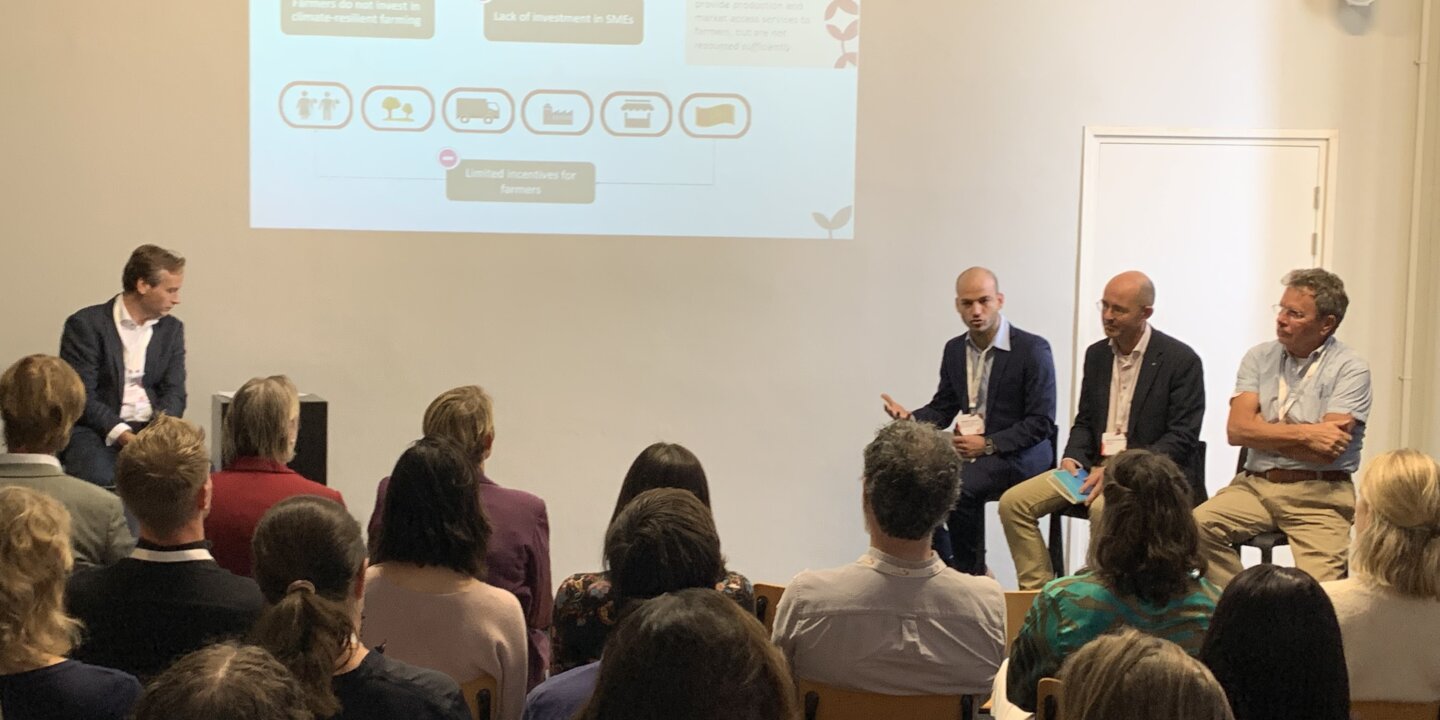
In the agricultural sector of Sub-Sahara Africa and beyond, a persistent "chicken and egg" problem exists. Farmers struggle to invest due to lack of access to finance a/o because of (perceived) risk, while Small and Medium Enterprises (SMEs) struggle to find consistent supply and finance to grow. During NFP’s World Food Day 2025, Tim Diphoorn (Europe director) of One Acre Fund brought together three distinct voices from the field to discuss how to de-risk the ecosystem, support farmers, and achieve scalable impact.
Three Perspectives on Growth
1. Jeremy Golan – Managing Director, One Acre Ventures
Jeremy Golan emphasized the necessity of "blended finance"—a mix of grants and commercial capital—to bridge the gap between smallholder farmers and stable markets. One Acre Ventures acts as an affiliate of the One Acre Fund, investing directly in local SMEs (such as an avocado oil processing plants in Rwanda).
Key Approach: Connecting part of their network of 5.5 million smallholder households to commercial markets.
Philosophy: Success requires balancing "impact-first" goals with strict "commercial discipline." By being local and understanding the farmers, they can assess risk better than distant banks.
2. Jaap-Jan Verboom – Managing Director, Truvalu
Jaap-Jan Verboom described Truvalu not as a bank nor as a consultant, but as "co-entrepreneurs." They provide capital (typically €200k–€500k) combined with intensive business support to help companies grow.
Key Approach: An "entrepreneur for entrepreneurs" model where local teams co-own the business risk.
Philosophy: "If you don’t plan for scale, you will never scale." Verboom argued that businesses must move beyond family-style operations to scalable models. He stressed that while margins in agriculture are thin, impact-linked finance (where returns are topped up by achieving impact goals, like carbon reduction) is a vital tool for viability.
3. Martin de Jong – Senior Business Development Advisor, Holland Greentech
Martin de Jong represented the technological side, focusing on inputs like irrigation and seeds. Holland Greentech operates across 12 countries, helping farmers transition from subsistence to profit through technology.
Key Approach: "We are not spreadsheet managers." De Jong argued that financing decisions cannot be made from a desk; they require "boots on the ground" to build trust and provide technical advice.
Philosophy: Finance in this sector requires patience. Unlike quick-turnover industries, agriculture needs a horizon of 4–5 years to see genuine development.
The Great Debate: Three Statements on the Future of Agri-Finance
During the interactive session, the panel and audience debated three controversial statements regarding the reality of the sector.
Statement I: With a growing population and food demand, agriculture is inherently bankable.
While the audience largely agreed due to the fundamental human need for food, the panel offered a nuanced reality check.
The Verdict: Demand exists, but "bankable" implies an ability to repay loans with interest. Martin de Jong noted that traditional banks rely on collateral, which many farmers lack. The sector is only bankable if you look beyond collateral to the business potential and provide the necessary technical support to ensure yield. As one audience member noted, efficiency and technology are required to turn "demand" into "bankability."
Statement II: Risk is overpriced in emerging markets, we have known this, and yet it is not changing.
There was a consensus that capital is too expensive for African farmers, often due to interest rates ranging from 20% to 27%.
The Verdict: Jeremy Golan explained that the market is "opaque," making it hard for banks to see the real risk, so they price it high out of caution. Jaap-Jan Verboom added a critical distinction: it isn't just about risk, but cost. Due diligence on small loans is expensive. If a bank has to spend thousands to vet a small loan, the interest rate rises to cover the transaction costs, not just the default risk.
Statement III: No impact-first fund can ever get to scale.
This statement challenged the room on whether prioritizing social, environmental and/or human impact prevents massive commercial growth.
- The Verdict: The panel pushed back against the idea that impact and scale are mutually exclusive. However, they agreed that "impact-first" cannot mean "ignore profit."
Jeremy Golan argued that you need an impact-first mindset, but you need commercial discipline to survive.
Jaap-Jan Verboom suggested that to scale, the model must change. Returns in primary agriculture are often too thin for traditional equity scaling. The solution lies in blended finance—using public funds or grants to de-risk the initial investment, allowing commercial capital to follow and scale the business.
Conclusion
The workshop concluded that while the agricultural sector in emerging markets is fraught with risks and thin margins, it is not uninvestable. The path forward lies in partnerships and blended finance—combining the patience of impact investors with the rigor of commercial banking and the technical expertise of boots-on-the-ground advisors.
Author

Lisette van Benthum
Partnership Builder