Learning to read the field, two legume fanatics on science that listens

Jens Andersson
Food security, climate resilience and sustainable food systems are challenges no country or institution can solve alone. They require trusted partnerships, long-term scientific collaboration and the ability to connect deep expertise with urgent global needs. In the next story of this blog series, we travel to smallholder farming systems in Tanzania, where researchers are asking how agronomic advice can become more than a recommendation from outside and instead help farmers learn to read their own fields.
The article follows the collaboration between Jens Andersson, farming systems scientist at Wageningen University & Research, and Frederick Baijukya, agronomist at the International Institute of Tropical Agriculture (IITA), part of CGIAR. Through the NWO-funded Senior Expert Programme in the NL-CGIAR research programme, their work focuses on translating agronomic research into scalable, locally relevant recommendations for smallholder farmers in Tanzania and Malawi.
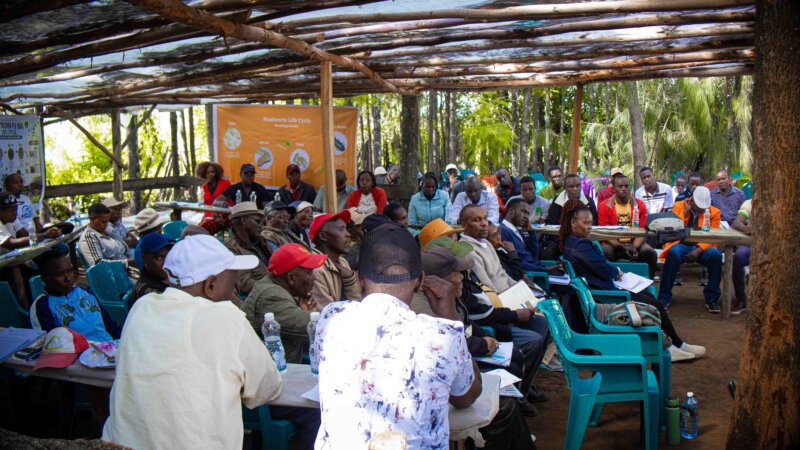
At the heart of the story is Agronomy at Scale, an approach that builds on digital advisory tools such as Farmer-MBA and links to AgWise, CGIAR’s platform for data-driven, tailored agronomic recommendations. Local extension agents visit farmers in their own fields, record field conditions and management practices, and generate advice on inputs such as fertilizer and seed. But the ambition goes further than delivering advice. The data flows back into the system, helping researchers refine recommendations over time and creating a feedback loop between farmers, extension agents and science.
Their collaboration shows why effective agricultural innovation is not only about developing better technologies, but about understanding how farmers actually work, learn and make decisions. Jens brings a farming systems perspective rooted in sociology and rural livelihoods; Frederick brings deep agronomic expertise on legumes, soil fertility and maize-based systems in Africa. One reads the farmer, the other reads the crop. Together, they show how science can listen as well as teach.
From improving soil fertility through legumes to helping farmers recognise what is happening in their own fields, this story illustrates what the Senior Expert Programme is designed to do: connect Dutch expertise with CGIAR’s locally embedded research, strengthen international collaboration and help ensure that science leads to real-world impact.
We would like to thank journalist Jasmijn Snoijink for capturing this story with depth and care, and Jens Andersson and Frederick Baijukya for generously sharing their time, expertise and reflections in the interview. We also gratefully acknowledge the collaborative efforts of CGIAR and NWO, whose partnership and commitment have helped make this series possible. We are also thankful for the additional support of Nienke Beintema (WUR), Timmo Gaasbeek (BZ), and Vera Musch (LVVN) in the process.
Interested in learning more about the NWO Research Programme?
The Netherlands (NL) - CGIAR research programme contributes to transformational change in agriculture around the world by advancing food system knowledge and joint public and private innovation. The programme is part of the strategic partnership between the Government of the Netherlands and CGIAR. A first Phase ran from 2017-2023, Phase II runs from 2024-2030. The NWO-funded Senior Expert Programme is one of its instruments.
Authors

Marjan Riepma
Partnership Builder

Mariëlle Karssenberg
Partnership Builder - Netherlands Food Partnership