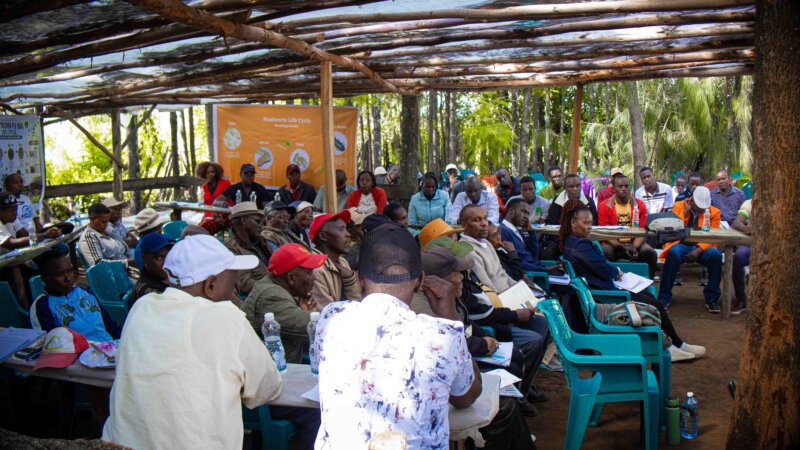
Black Soldier Fly Larvae (BSFL) farming exemplifies circular economy principles by converting diverse organic waste streams into nutrient-rich larvae, lipid fractions, and frass, thereby enhancing resource efficiency. The focus of this research is specifically on using BSFL (Hermetia illucens L.) as feed in the aquaculture sector with the intention to reduce costs for the farmers given the current high price on commercial feed in Uganda.
An effective and more affordable alternative to commercial feed could have a significant impact on the aquaculture sector, as community farmers often operate at break-even levels. BSFL, and feed formulations that include BSFL, can be used in production systems such as pond-based fish farming, which faces challenges of limited access to commercial feed. In these cases, cost-effective production where commercial feeds are not financially viable can contribute to increased income, local employment, and enhanced food and nutrition security in communities. Moreover, replacing fishmeal and imported soymeal with BSFL-derived ingredients reduces pressure on overexploited fish stocks, which are often used as protein sources in feed, and lowers emissions associated with long-distance feed supply chains.
When scaled, BSFL production advances multiple Sustainable Development Goals (SDGs) by improving household income, strengthening food and feed security, promoting safe and sustainable urban waste management, and supporting climate change mitigation. To reach these benefits, community farmers can produce BSFL as feed ingredient on their farm. Still, the uptake of BSFL among community farmers carrying out mixed farming is surprisingly low. Although high interest among community farmers is observed, a conducive context with favourable conditions is a precondition for profitability. However, it is unclear what these conditions are in practice.
The main aims of this study are twofold:
- To explore the role Black Soldier Fly (Hermetia illucens L.) Larvae (BSFL) as a regular component of fish feed among community farmers in Uganda and identify core bottlenecks, needs and opportunities for increased uptake to prepare for scaling.
- To provide actionable recommendations to support further realistic scaling up of BSFL use, acknowledging the adoption steps and the different contexts in which local aquaculture farmers operate.
The study show that for small-scale farmers, BSFL can help reduce the cost of animal feed, create extra income, and improve waste management. Farmers could work more closely with waste pickers, which would help secure better-quality organic waste while also creating more inclusive local value chains. Demonstration sites and farmer hubs can help build trust, share knowledge, and involve farmers early in testing and decision-making. Awareness campaigns are also important, because they can reduce stigma and make communities more open to using insect-based products. BSFL production could also create new jobs, especially for young people.
For medium-scale farmers, BSFL offers opportunities to produce feed commercially on farms and to combine insect farming with other types of farming, such as poultry, fish, or crops. Farmers could sell different BSFL products, including larvae, eggs, pupae, protein meal, oil, and frass, which can be used as fertiliser. Better waste collection systems, safety rules, and professional services could make supply chains stronger and create more jobs. Farmers should also have a stronger voice in public-private partnerships, so that policies, budgets, and business models reflect their actual needs.
For large-scale systems, BSFL can benefit from economies of scale, meaning larger operations can produce bigger volumes more efficiently. This could help supply regional feed and fertiliser markets. Large-scale BSFL businesses could also turn industrial waste into useful products, attract investment, and support research and policy learning. Clear budgets, good governance, and farmer-inclusive partnerships can reduce risks for investors and support a shift towards a circular bioeconomy. Large-scale production could also provide feed millers with reliable, high-quality BSFL products, helping to build stable value chains.
In simple terms: BSFL can lower feed costs, turn waste into value, create jobs, support young people, and help build more sustainable food and farming systems - but it needs strong partnerships, good waste systems, farmer involvement, and supportive policies to grow successfully.
More information?
This study was conducted by Soma, K., Juma, F.O., Tenywa, M., Ndambi, A., Naser El Deen, S. and Kanyuguto, C.M. from Wageningen Social & Economic Research and project partners and commissioned and financed by the Federal Ministry for Economic Cooperation and Development (BMZ), Germany, in the project called: Black Soldier Fly Larvae as fish feed.
Author

Ibrahim Palaz
Partnership Builder