Unpacking the Challenges of Measuring Transformative Food Systems Finance - Webinar Video
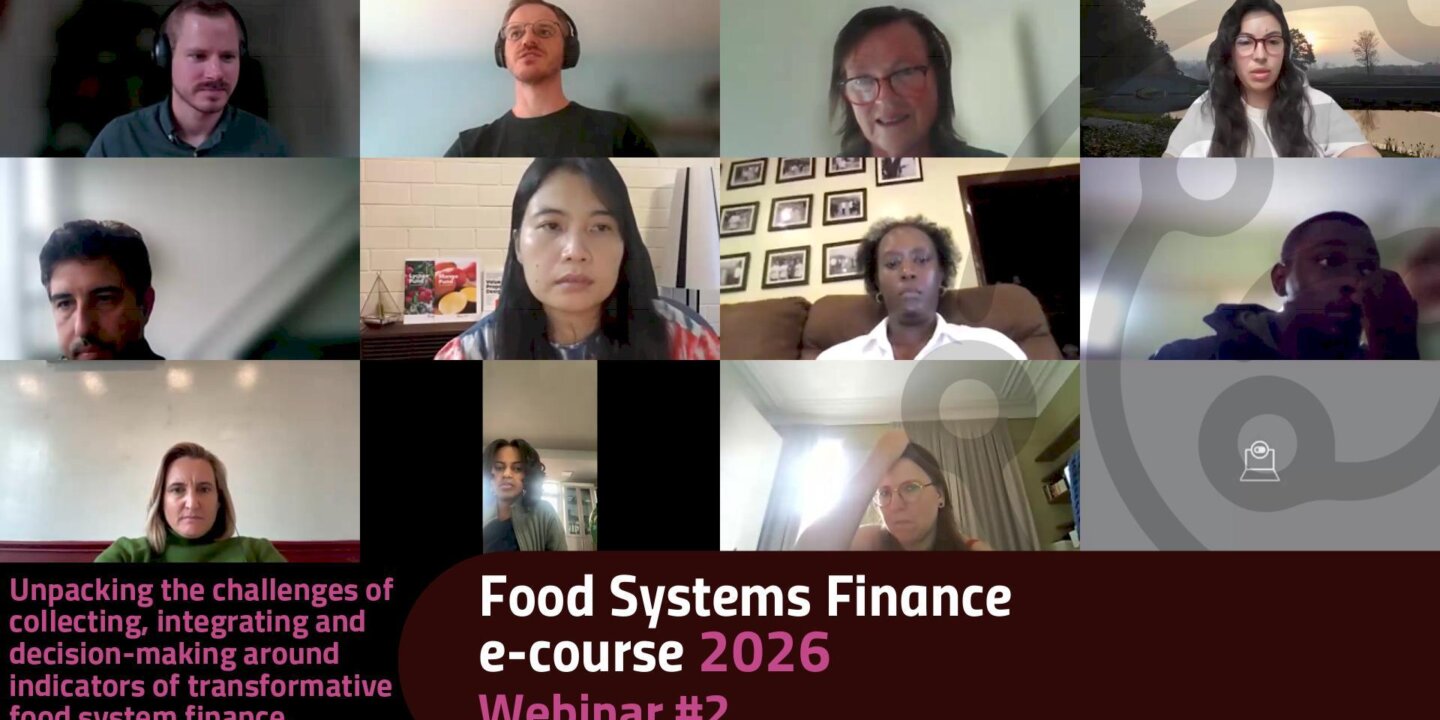
How do we know whether food systems investments are truly creating transformative change? This session brought together researchers, investors, and practitioners to discuss the complexities of impact measurement and the role of evidence in shaping more effective food systems finance.
The second plenary session of the 2026 Food Systems Finance e-course took place on 3 June, bringing together participants, practitioners, and researchers to explore a critical question in food systems finance: how can we better measure, integrate, and use data to support decision-making and transformative change?
Under the theme “Unpacking the challenges of collecting, integrating and decision-making around indicators of transformative food system finance”, the session featured expert presentations from Dr. Haki Pamuk of Wageningen Economic Research and Daniela Arias Rivera of Triodos Investment Management, followed by participant reflections and an interactive discussion.
Measuring What Matters—and Using It
Opening the session, Dr. Haki Pamuk, Senior Researcher and Impact Economics Program Lead at Wageningen Economic Research (WUR), examined the dual mandate faced by many investors: contributing to transformative change while also achieving financial returns.
Starting with the observation that “What’s measured is what matters, but measurement alone is not enough”, Haki challenged participants to think beyond data collection and consider how impact information is actually used in decision-making processes.
He presented three key pillars for measuring and evaluating investment impact: intentionality, additionality, and applicability. While significant attention is often given to defining objectives and measuring outcomes, Haki noted that a major gap frequently exists in the third pillar—applying evidence to improve investment decisions, risk management, and future interventions.
Drawing on experiences from impact investment and food systems research across Africa, Asia, and Europe, he offered several practical recommendations. These included embedding evaluation design from the beginning of investment programmes, making greater use of administrative and monitoring data before launching costly primary data collection efforts, conducting in-depth studies to test innovative financing instruments, and integrating evaluation findings into risk management frameworks.
Navigating Trade-offs in Impact Measurement
Daniela Arias Rivera, Impact Specialist at Triodos Investment Management, brought a practitioner’s perspective on how impact measurement is approached within investment portfolios operating in emerging markets.
She introduced Triodos’ vision for food and agriculture systems, which emphasises local value creation and distribution while contributing to balanced ecosystems, healthy societies, and inclusive prosperity.
Drawing on the experience of the Hivos-Triodos Fund (HTF), a blended finance fund with more than three decades of experience, Daniela illustrated how investments can simultaneously address climate challenges, strengthen rural livelihoods, support renewable energy solutions, and reduce inequalities.
At the same time, she highlighted the complexities and dilemmas involved in measuring impact. Participants reflected on questions such as: How much should indicators be tailored to individual investees? Who actually benefits from increasingly frequent data collection? How can investors balance attribution and proportionality when assessing impact? And to what extent can a single investment legitimately claim responsibility for observed changes?
These questions sparked lively discussion among participants and underscored the reality that impact measurement is rarely a straightforward technical exercise. Rather, it involves balancing accountability, learning, practicality, and decision-making needs.
From Data Collection to Better Decisions
Throughout the session, participants contributed their own reflections through Mentimeter exercises and discussion, sharing perspectives from different sectors, countries, and professional backgrounds.
A recurring theme was the need to move beyond collecting data for reporting purposes and towards using evidence more effectively to guide investment choices, improve accountability, and accelerate food systems transformation.
The conversation reinforced a central message of the Food Systems Finance e-course: finance is not only about mobilising capital. It is also about understanding what works, learning from evidence, and making informed decisions that contribute to sustainable, resilient, and inclusive food systems.
If you missed the session, the webinar recordings are available below and on the NFP YouTube Channel.
Authors

Gizaw Legesse
Content Creator

Lisette van Benthum
Partnership Builder