Doing Food Systems Financing Differently: A Call for Change
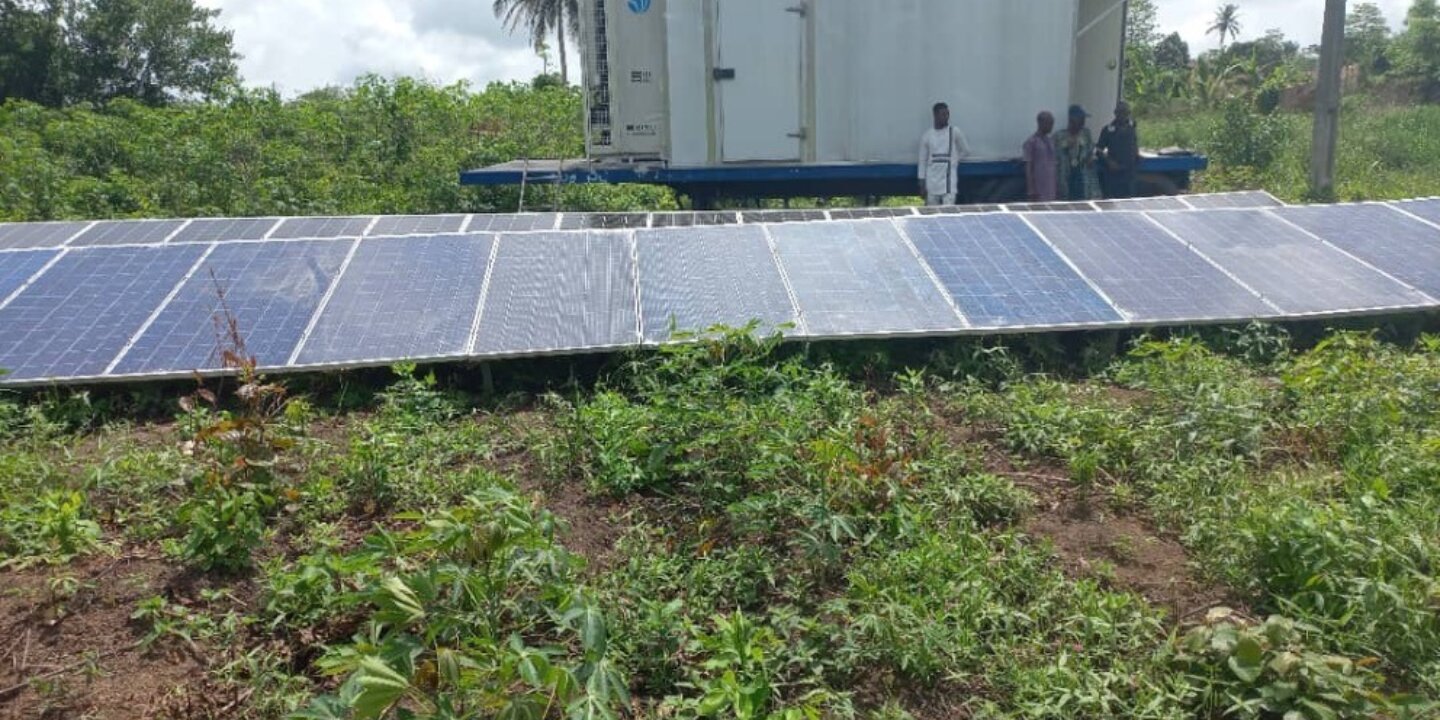
In 2022, I led the deployment of this solar-powered mobile cold storage facility for shared use in Irawo Community, Ogun State, Nigeria, under IFC’s TechEmerge programme. This initiative helped fruit and vegetable farmers reduce post-harvest losses and exemplifies the shift toward sustainable financing and best practice adoption. Picture taken on April 16, 2023.
Simeon Alfa is a development finance specialist, currently working at Wema Bank in Nigeria as Head of the Agricultural and Non-Oil Export Finance Department. As a participant of the Food Systems Finance e-course from Nigeria, he writes to inspire new ways of thinking to finance food systems.
Change is often described as the only constant in life, and nowhere is this more visible than how we finance our food systems. For too long, the sector has faced a persistent funding gap. Despite growing awareness of climate risks, nutrition challenges, and market volatility, traditional financing models have struggled to deliver the outcomes we need.
What continues to puzzle me is not the lack of capital, but how risk is understood and managed in food systems. Investors naturally seek returns, yet food systems are often viewed as uniquely risky, sometimes without sufficient understanding of how those risks operate. As a result, financing tends to focus on a few “safer” segments, leaving critical parts of the system underfunded.
This became very real to me in 2019, when I was struggling to secure funding for Foodland Mills Limited, a rice mill that I facilitated its establishment in Nasarawa, Nigeria. Traditional financiers saw the project primarily as a risky start-up. It was only when a non-bank financial institution looked beyond that label—trusting the financing model and risk-mitigation strategies I had developed—that the project secured initial working capital.
That experience stayed with me. It showed me that when financiers truly listen to the food system, rather than relying on assumptions, more sustainable outcomes become possible.
Although tools to mitigate risk already exist, many financiers remain hesitant. Decisions are often shaped by outdated perceptions, past failures, or limited sector knowledge. These perceptions, I have come to believe, cannot simply be de-risked; they must be challenged through better intelligence and a deeper understanding of food systems as interconnected systems.
This was where the Food Systems Finance e-course came through for me. It deepened my understanding of food systems beyond isolated activities such as production or processing, highlighting their interconnected impacts across ecosystems, health, livelihoods, and prosperity, with finance being a key driver.
Our current approach to producing, processing, transporting, and consuming food remains unsustainable. Practices such as deforestation for cultivation, unsafe processing, poor storage, and wasteful disposal continue to contribute to climate change and public health challenges. The urgency to transition towards food systems that ensure both environmental sustainability and human wellbeing is undeniable.
Financing such a transition, however, requires more than financial capital alone. It also demands natural, social, and human capital. And, perhaps most importantly, a willingness to ask the right questions. Can we reduce financial exposure to environmentally harmful businesses by integrating biodiversity risk scores into credit models? Can we incentivize sustainable practices across value chains? Can financing move beyond production to support affordable nutrition and improved health outcomes? And can we leverage innovative financing models to expand access to appropriate finance?
These are not abstract questions. They are practical entry points for rethinking how finance shapes food systems. To finance food systems differently, we need a credit framework that values environmental and social outcomes alongside financial returns—a point that surfaced in the insightful conversations during the e-course.
Ultimately, a just food system that supports healthy societies and inclusive prosperity is possible. Achieving it will depend on our willingness to challenge old assumptions, listen more to how food systems function, and use finance more responsibly. It is my hope to see a meaningful shift in how we think about and finance food systems.
—
Disclaimer: The views and opinions expressed in this blog are solely those of the author and do not necessarily reflect the views, policies, or positions of any organisation with which the author is currently or has previously been affiliated.
Author

Simeon Alfa
Food System Finance e-course Cohort