Integrated Farming: A Holistic Approach to Sustainable Food Systems
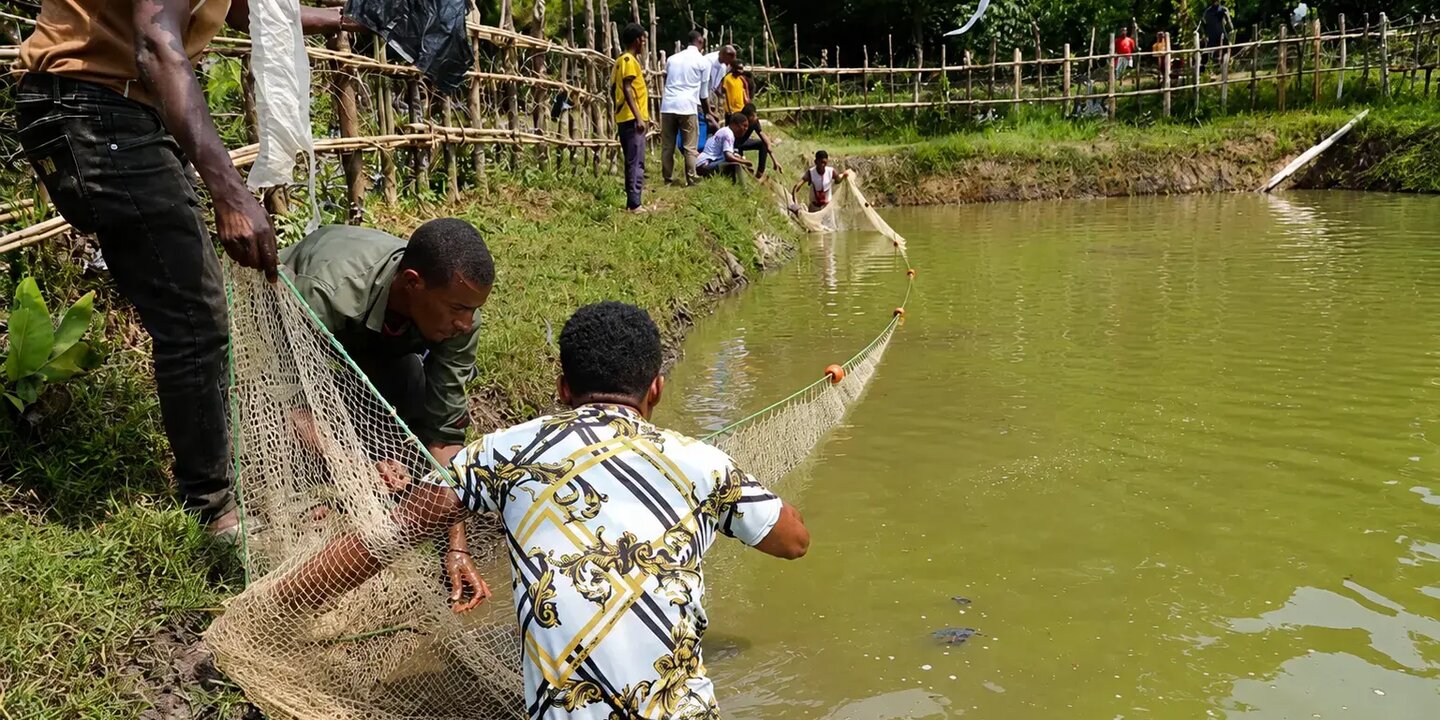
Farmers harvesting fish from a system, southwestern Ethiopia, 2025. Picture by Ahmedin (JUCAVM).
Eyerus Muleta is a researcher and lecturer at Jimma University in Ethiopia, with strong interest in integrated food systems and community nutrition. As a participant in the 2026 Food Systems e-course, she reflects on how integrated farming practices in southwest Ethiopia are improving nutrition, livelihoods, and environmental sustainability.
A circular food system can offer a sustainable solution to the growing demand for food and household income in a climate-stressed environment. My personal experiences, supported by scientific evidence, shows that integrated farming improves yield, increases income, and maintains soil and water health while reducing waste and emissions.
One of our most impactful pilot projects in southwestern Ethiopia focused on integrating chicken, fish, and vegetables. This project improved livelihoods by enhancing nutrition and increasing household income, and it has gradually gained acceptance for wider community adoption.
We introduced the pilot in Nada Woreda, Jimma Zone, where fish farming and consumption were initially unfamiliar to the community. To address this, we provided capacity-building training ranging from pond construction to fish management and consumption practices.
Today, farmers are increasingly including fish in their diets. In some cases, it is used to support children showing symptoms of protein deficiency, locally known as “Hudhaa ijoollee,” often characterized by a swollen stomach.
Why Integration Matters
Integration of chicken, fish, and vegetables is important because it improves productivity, household income, and dietary diversity. Families are able to consume what they produce while also generating income from surplus.
Combining animal-source foods such as fish, eggs, and meat with vegetables improves nutrition and helps reduce deficiencies in protein and micronutrients. The system also creates a more environmentally friendly production approach through better resource efficiency and lower greenhouse gas emissions.
How the Model Works
In practice, this integration works through nutrient recycling. Poultry provides nutrients for fish, fish act as bio-converters, and vegetables maintain water quality for fish while absorbing and recycling nutrients. This reduces the need for external inputs such as feed and fertilizers, which are often costly and can also harm the environment.
However, implementing such a system is not always easy. People often resist new ideas. Farmers need to change from being "consumers of inputs" to becoming "managers of cycles." This requires a change in mindset, along with careful attention to waste management, water quality, and basic biosecurity practices.
One major challenge we faced was introducing fish farming in a community with no previous experience in fish production or consumption. We started with 10 model farmers, and progress was initially slow. However, through training, demonstrations, and peer learning, farmers began to trust the approach. Within a year, the practice expanded to more than 140 farmers highlighting the importance of gradual, community-led change.
Participating in the Food Systems e-course helped me further analyse and reflect on these experiences. In particular, the concept of systems thinking and the food systems framework encouraged me to see more clearly how production, nutrition, livelihoods, and environmental sustainability are interconnected in practice.
This integrated model offers a practical holistic approach to building resilient food systems. To scale such approaches further, we need to invest more in training, local capacity building, and supportive policies.
Author

Eyerus Muleta Fatula
2026 Food Systems e-course Participant