We All have a Role to Play: Collective Action in Food Systems Transformation
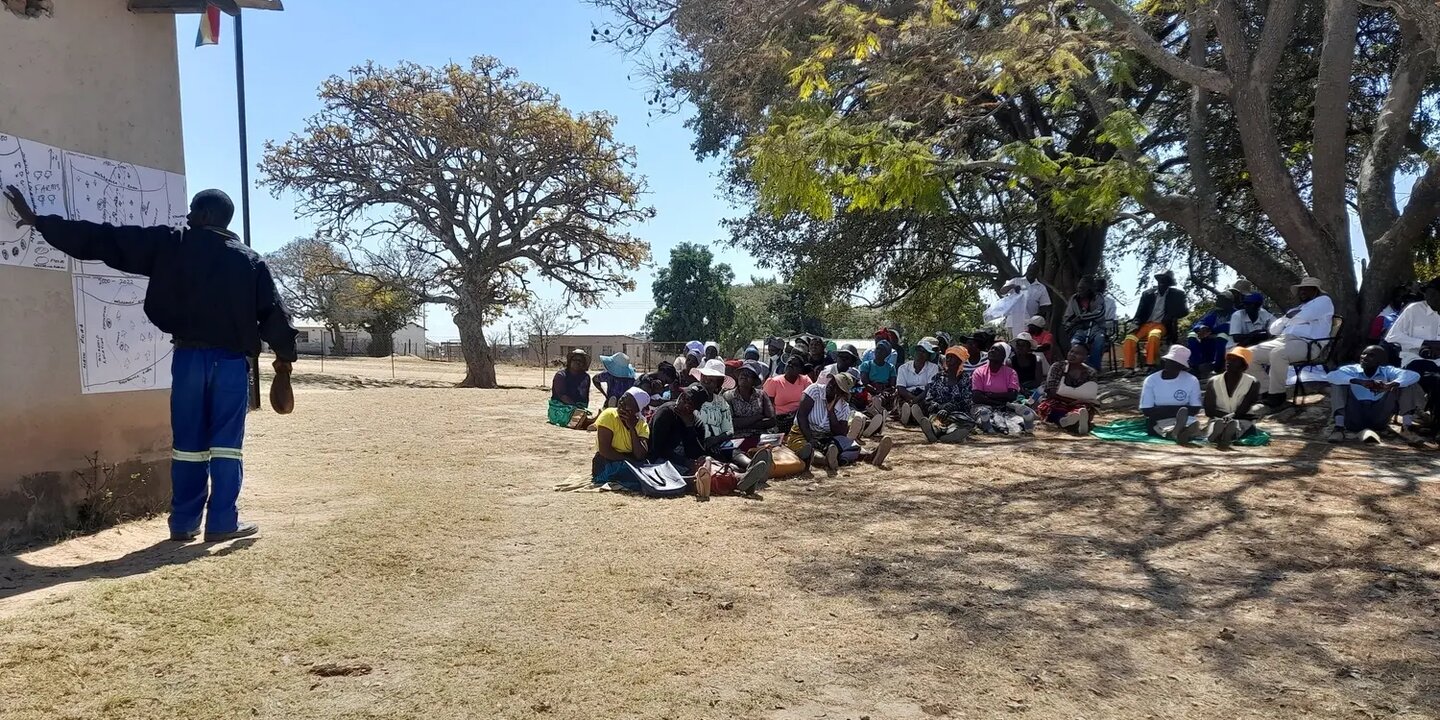
Community-led village level, natural resource mapping to assess impact of current farming systems on the environment and biodiversity. Makoni District, Manicaland Province, Zimbabwe. Picture by Maria Goss. August 2022.
Dr. Maria Goss is the National Coordinator for Sustainable Agricultural Livelihoods and Technologies (SALT), a community-based organisation in Norton, Zimbabwe. As a participant of the 2026 Food Systems e-course, she reflects on how collective action and multi-stakeholder dialogue can drive more inclusive and effective food systems transformation, looking back on her own professional journey and experience.
Is it policy environments that determine food system transformation, or do we all have a role to play?
From my experience working across food systems, spanning food and nutrition security, agricultural livelihoods, farming systems, and agroecology, I have observed a persistent gap: limited strategic dialogue between policy makers, sectoral actors, and localised stakeholders. These groups often operate in parallel, with little coordination or shared understanding.
But let us not panic. This gap is not too great to overcome. With clearer roles, stronger coordination, and more inclusive dialogue, it is possible to align efforts and create more enabling policy environments for food systems transformation.
Participating in the Food Systems e-course helped me reflect on this more critically. Concepts such as governance structures, stakeholder roles, system boundaries underline that transformation cannot be achieved by policy alone. It requires coordinated action and meaningful engagement across all actors.
This became evident during my work in Zimbabwe. Between 2018 and 2019, I collaborated with several like-minded organisations to support the formation of the Zimbabwe Seed Sovereignty Program (ZSSP), initially bringing together six community-based organizations and one international NGO.
Was this an easy task? It was a start. ZSSP grew into a national consortium focused on raising awareness, sharing knowledge, and generating collective evidence to inform policy and advocacy on food and nutrition security.
Through continued engagement with diverse stakeholders—including from the Ministry of Lands, Agriculture, Fisheries, Water and Rural Development—this work contributed to the formation of an agroecology Community of Practice, the Zimbabwe Alliance for the Promotion and Practice of Agroecology (ZAPPA).
This is where it gets more interesting. I was appointed to serve as chairperson (2019–2022), leading national multi-stakeholder dialogue processes under the National Agriculture Policy Framework (NAPF Pillar 8) on resilient and sustainable agriculture.
In this role, I facilitated dialogue forums, coordinated stakeholders across different levels, and supported the development of implementation frameworks. Through field visits and discussions—from national to village level—policymakers, researchers, private sector actors, and farmers were able to engage directly, learn from each other, and contribute to shaping policy.
These efforts contributed to the development of a draft policy on organic farming and agroecology policy, later adopted as the Agroecology Strategy under NAPF Pillar 8 in 2024.
However, developing a strategy is only one step. The real challenge lies in implementation at scale. Despite progress, gaps remain in coordination, resource mobilisation, and sustained engagement across stakeholders. What worked for me was bringing marginalised smallholder farmers and policymakers together, allowing each to better understand the other’s role and contribution to more sustainable food and nutrition systems. We need more of these structured dialogue platforms, held regularly, to support informed policy and effective implementation.
Looking ahead, tools such as food systems mapping and structured governance analysis—explored in the e-course—offer opportunities to strengthen coordination and improve implementation.
Upon reflection, food systems transformation cannot be driven by policymakers alone. It requires collective action, where every stakeholder plays a critical role in shaping more inclusive and sustainable outcomes.
Author

MARIA GOSS
2026 Food Systems e-course Participant