Beyond the Factory Gates: The Unsung SHEroes of Urban Food Systems
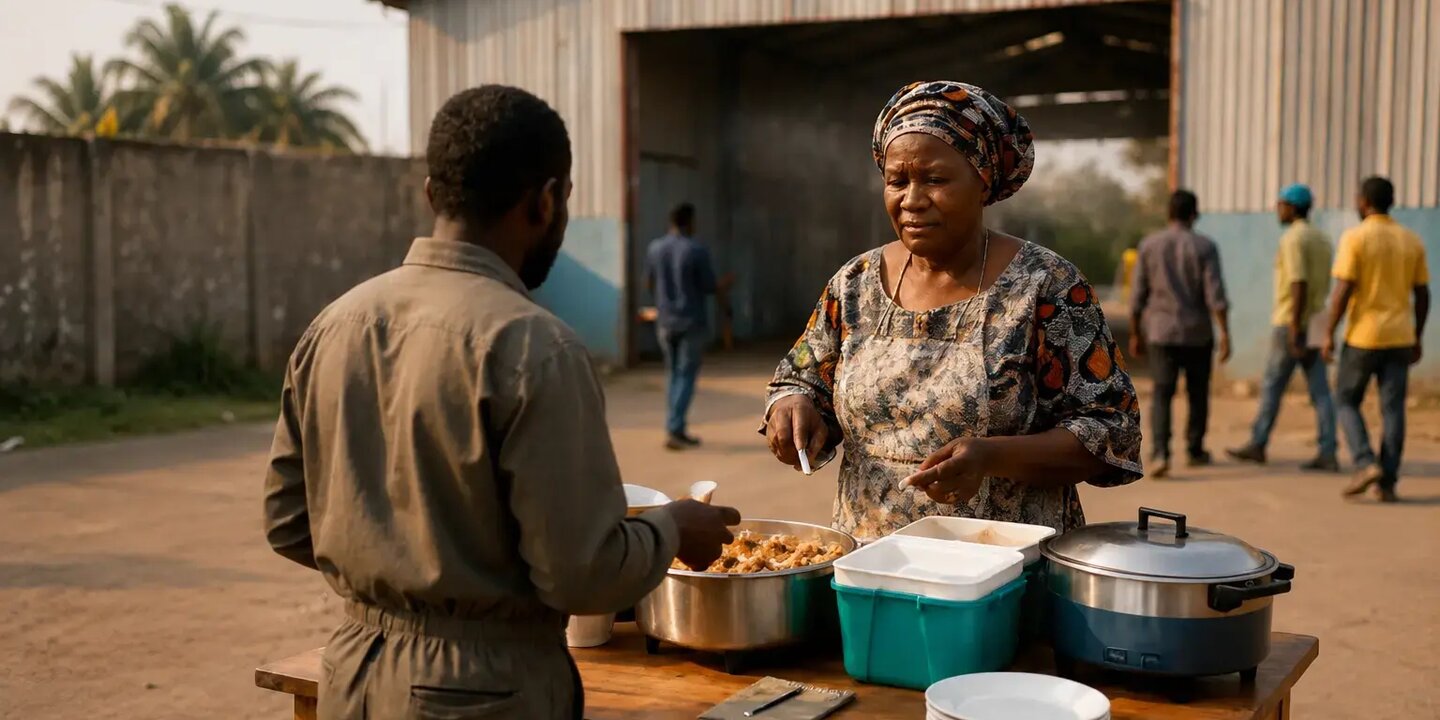
Factory-site food vendors are the unsung backbone of urban food systems. (AI generated Image)
Olubukola Funsho-Sanni is a GESI and Market Systems Development Specialist and PhD candidate with over 12 years of experience in inclusive food systems. A participant of the 2026 Food Systems e-course from Nigeria, she reflects on the role of factory-site food vendors and why recognising them is key to more inclusive urban food systems.
It started as a normal day of learning—level 3 of my e-course on Food Systems: The Power of the Informal Economy: Case Studies. As the documentary footage rolled, a memory surfaced.
I saw her: a woman behind a table of steaming food warmers, plates, and spoons, serving workers in front of a factory building where I had spent countless afternoons growing up.
At that moment, I felt like a villain and a hero simultaneously.
The Villain: A Case of Indifference
For years, she was only part of the scenery. Yet she was the lifeline for the factory shifts. Workers ate on credit, and she tracked every meal in a handbook, waiting for payday to settle accounts. But the system was rigged.
Whenever a worker became a “no-show”—whether by choice or termination—she bore the loss. Cries to management fell on deaf ears because no formal agreement protected her.
Looking back, my indifference was a symptom of a systemic blind spot. I saw a vendor, not a critical actor in the food system.
The Hero: Designing for Agency
Behind my laptop, as a Gender Equality and Social Inclusion specialist, I use a different lens. The “villain” of my past perception gives way to recognising her as a “SHEro”.
Her situation is not bad luck. It is a lack of structural agency.
Addressing this requires transformative actions:
Tripartite agreements: Formal arrangements with factory management to ensure vendors are informed of staff exits before payday or guarantee credit settlement.
Business formalization: Registration, proper record-keeping, and financial literacy to unlock access to credit and investment opportunities.
Collective action: Vendor associations that move from being “allowed’’ at factory gates to recognised partners in the system.
These interventions reflect key concepts from the e-course: structural agency and making informal actors visible within the formal food system governance. Advancing toward systemic inclusion enables these SHEroes to gain the institutional recognition and financial protection they need.
The Unspoken Gender Dimension
Factory-site food vendors are the unsung backbone of urban food systems. A large share of low-income industrial workers in Nigeria depend on them, and these vendors—mostly women—play a pivotal role in safeguarding food access and nutrition.
Yet they operate at the intersection of informal work and unpaid care. Without contracts, financial services, or a voice in decision-making, they remain invisible within the food system. They have little to no protection.
The COVID-19 lockdowns revealed this vulnerability. When factories shut down, their income and capital disappeared overnight.
The Bottom Line
These women are not peripheral but central to how urban food systems function, connecting food access, labour, and informal finance.
Participating in the Food Systems e-course helped me recognise that food systems are shaped not only by policies and markets, but also by the everyday actors who sustain them.
If we are serious about resilient food systems, we must include the women at the factory gates. With better structure, stronger agency, and greater financial inclusion, we do not just support individual livelihoods—we stabilise and strengthen the entire urban food system.
Author

OLUBUKOLA FUNSHO-SANNI
2026 Food Systems e-course Participant