Building a Just and Sustainable Food Future: EAT-Lancet 2025 in action
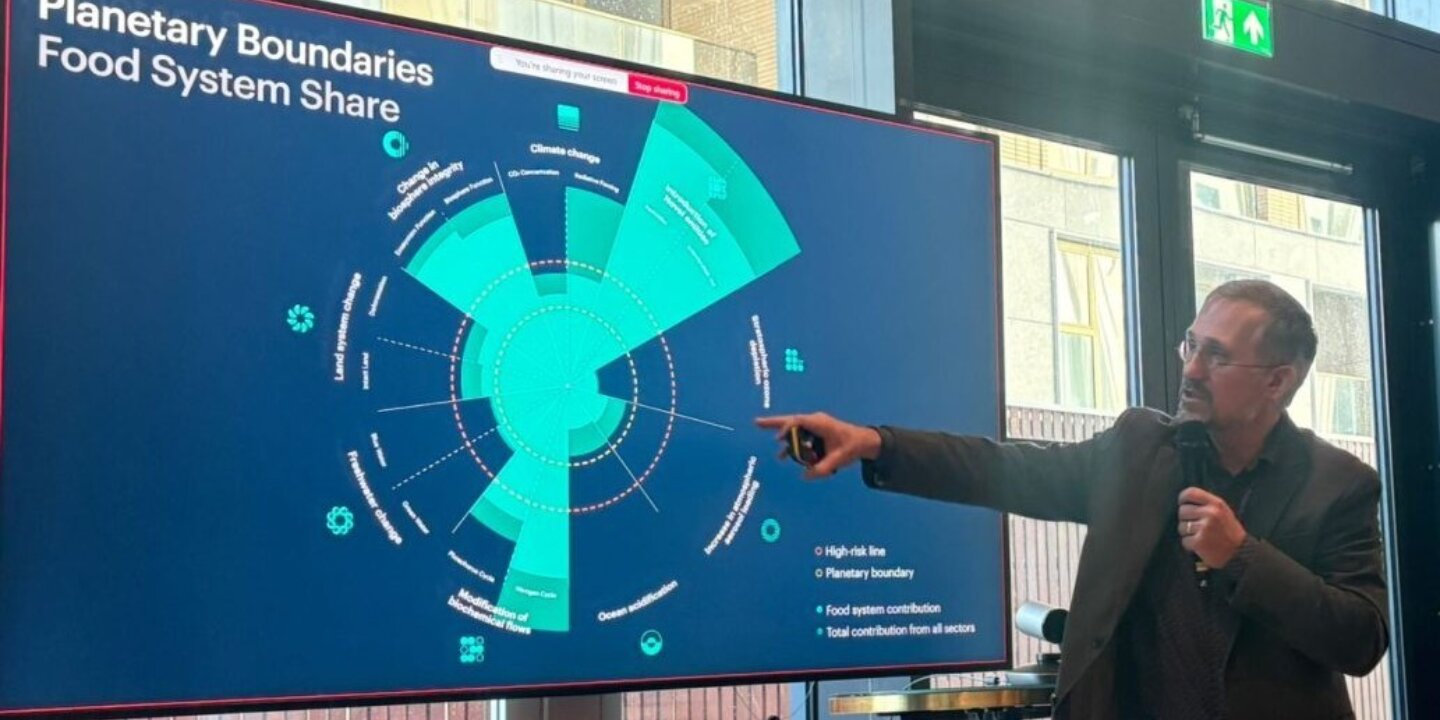
Dr. Fabrice DeClerk: "Food system boundaries confirm that food is the single largest cause of planetary boundary transgressions."
This blog describes the key takeaways from the NWGN & NFP EAT‑Lancet 2.0 gathering in The Hague, 26 February 2026.
Is it possible to enable access to healthy diets for all people in the world by 2050, while staying within planetary boundaries? The new EAT-Lancet Commission report, published late 2025, provides the scientific evidence that these objectives can be achieved together. It describes four future scenarios and a range of recommendations. In February 2026, Dr. Fabrice DeClerck of the EAT-Lancet Commission presented the report in The Hague, during a dialogue event hosted by NWGN and NFP, with about 50 Dutch experts from universities, civil society organisations, private, and public sector. The participants saw a range of opportunities to turn the research findings and the recommendations into practice (scroll down to read these recommendations).
The 2025 EAT-Lancet Commission is a scientific update on what defines a healthy, sustainable and just food system in today’s world. Its research builds on earlier work done by the Commission, that in its turn was informed by the work on planetary boundaries and doughnut economics.
About ten years ago, Kate Raworth published her book, “Doughnut Economics” popularising the ideas developed by Johan Rockström of the Stockholm Resilience Centre of planetary boundaries which earth’s systems processes must stay within to prevent catastrophic climate change. While the earth’s systems have finite limits, humans also have minimum social needs, including water, energy, housing, health, education, and work, to name a few. How do we, as society, find a way to operate in this “safe operating space”? How does this specifically apply to food and the food system?
The first EAT-Lancet Commission came together in 2016 to answer these questions, trying to establish the safe operating space for the food systems. What would the food system need to produce, both to ensure people are able to access a healthy diet, while at the same time ensuring we do not transgress planetary boundaries? Its report, Food in the Anthropocene: the EAT-Lancet Commission on healthy diets from sustainable food systems was released in 2019. The report sparked considerable debate, but also started a critical conversation on what needs to change to support both human and planetary health.
The second EAT-Lancet Commission continued the discussion, and updated the paper based on new research and scientific findings. The findings of the second Commission were released at the end of 2025. What is new in the 2025 version, EAT-Lancet 2.0?
The Planetary Health Diet remains largely unchanged
There is growing global consensus on what a healthy diet looks like, and what dietary patterns have the greatest public health benefits. The Commission synthesised recent research on health outcomes of food consumption patterns, as the basis for a recommended ‘planetary health diet’. It includes options for vegan, vegetarian, pescetarian, and meat-eating versions of the diet, with two day meal plans to show how it could be applied to a wide range of cultures and eating habits globally. The Commission found that across all regions, people are consuming insufficient fruits and vegetables, nuts, legumes and whole grains. It provides extensive data on regional differences in dietary patterns and nutrition outcomes.
Food systems are one of the primary drivers of planetary boundary transgressions
The food system is the main contributor to the transgression of 5 planetary boundaries: climate, freshwater, nutrients, pollution, and novel entities (pesticides, antimicrobials, and microplastics). Specifically, the commission found an urgent need for pesticide reduction and more region-specific approaches to nitrogen use and resource redistribution. On climate, we need to decide on CO₂-equivalent budgets for food systems and accelerate reductions in methane and nitrous oxide emissions. While reducing meat consumption was identified as highly impactful, it was also acknowledged as politically sensitive, with technological solutions often gaining more traction than consumption-based changes.
There are some regions, especially in many low-and-middle income countries, that are performing quite well according to some planetary boundaries. One of the key questions is: how to maintain this performance as people start to transition to more “western” type diets, and also recognising challenges that people, especially vulnerable groups, may still struggle to meet their nutrient needs? (This is a question the NWGN has been exploring, including producing a position paper on animal-sourced foods in low-and-middle-income countries.)
Justice is a greater priority in EAT-Lancet 2.0
The 2.0 report integrates social foundations, human rights and equity. This means it includes both elements of ensuring fair access to food and to a healthy, safe environment and living wage for food systems workers. Fewer than 1% of the world’s population is currently in the ‘safe and just space’, where people’s rights and food needs are met within planetary boundaries. While at the same time, a small percentage of the population are driving the majority of the food related planetary impacts. Ensuring justice is critical, however it also remains the area that the Commission found the hardest to model.
What do the EAT-Lancet Commission recommendations look like in practice?
Food systems transitions are happening in all parts of the world and need to happen to allow for the ambitions of the EAT-Lancet Commission to be realised. These transitions are not homogeneous, as the scenarios described (e.g. ‘EAT-Lancet World’ versus ‘business as usual’) have different regional implications. A recurring concern is to turn the ambition into actual measures that implement the transition, even if scientists still need better insights into the effectiveness of possible interventions and of how the models connect to real world action. The Commission attaches importance to building a community of actors to work with, which they did during the recent Stockholm Food Forum 2025 which formulated the next steps for the commissions work. It initiated Communities for Action as a basis for future joint action.
Interested in the full report "The EAT-Lancet Commission on healthy, sustainable and just food systems? Find it here
Dutch network actors share their experience
Four case studies were presented, providing concrete examples of what implementing the EAT-Lancet commission recommendations looks like in practice.
- Supporting refugees and host community to access healthier diets. SNV is supporting internally displaced persons to grow fresh fruits and vegetables, to increase their dietary diversity and improve their incomes as part of the Community Resilience in the Agro-Sylvo-Pastoral
Sector (ResCom) project, implemented in three regions of Burkina Faso. - Increasing year-round access to African Indigenous Vegetables. Bopinc is working with small‑scale fruit and vegetable processors in Kenya as part of the 2scale project, supporting local entrepreneurship to increase year-round access to affordable, nutritious dried African indigenous vegetables. One such entrepreneur is Mercy, who dries indigenous fruits and vegetables and turns them into nutritious products tailored to local tastes. By elevating often‑overlooked native crops, entrepreneurs like her help diversify diets while strengthening regional value chains. Mercy also collaborates with women’s groups for last‑mile distribution, demonstrating how inclusive business models can expand access to healthy foods and employment opportunities.
- Supporting the transition to plant-based proteins in India. Schouten Family Companies is working with small scale producers in India to support local production of tempeh. While meat replacements, such as plant-based burgers, sausages, chicken and fish, are becoming more common in the Netherlands and other European countries, they have low acceptance in India, where people feel vegetarian foods should be in ‘natural’ form and not presented as ‘fake meat’. The company has been working with small scale producers to introduce tempeh to the Indian market, developing a model which creates scalable options of local tempeh production, while also creating jobs and increased access to high quality plant based proteins.
- The Food & Agriculture Benchmark. Insights from the upcoming World Benchmarking Alliance recently released the 2026 Benchmark underscore how far the global food industry still has to go on sustainability. After assessing 250 food and agriculture companies, the average score was only 15.5 out of 100, highlighting major gaps between optimal practices and the current state of play. At the same time, momentum is growing: more companies are reporting on regenerative agriculture, and over a quarter now engage in developing plant‑based protein alternatives. The benchmark also notes encouraging improvements in the nutrient profiles of products, signalling that healthier and more sustainable diets are increasingly part of corporate strategies.
Lively interactions
In the second half of the session, participants had a chance to break into small groups and reflect on the findings. Some key reflections:
1. The central question and challenge is how to act at the intersection of these three dimensions. “Being systemic on the ground is difficult.” While the EAT-Lancet 2.0 report presents substantial data sets and models future developments, it is clear that more research is needed to find the most effective bundle of policy interventions which supports both increased access to affordable, nutritious diets while at the same time reducing environmental and climate impacts.
2. Where to start? Bottom-up, working closely with citizens, city and local governments where people are more invested? Or top-down, changing national policies, international trade regulations and directives?
3. The EAT-Lancet 2.0 report seems to confirm that several organisation’s partner programmes in Sub Sahara Africa are doing the right things already. A question that arose was whether the international actors working in the same context are on board too for that agenda, for example international foundations or trading partners.
4. What does justice mean in practice? How do we balance the needs of all the actors in the food system? If we make active choices to change the trajectory of the food system, what does this mean for the “loser”? Actors were called upon to take responsibility for a just process. Participants agreed that decision making across systems is difficult.
5. How can we simplify the dissemination of dietary guidance? The conversation highlighted the need for user-friendly, actionable information that meets people where they are, whether through community programs, digital tools, or simplified messaging.
6. Sustainable healthy diets must be framed as a smart investment for countries. Participants emphasized the importance of creating a compelling business case, demonstrating how prevention-focused diets can reduce healthcare costs and boost national productivity. They also considered the food systems boundaries concept as useful to quantify investments into reduced environmental impact. Hence, these elements could help redirect national budgets toward supportive policies and incentives.
7. One size does not fit all. The discussion underscored the essential role of cultural relevance and local context in promoting dietary change. Successful interventions must respect traditions, local foods, and community values to gain traction and sustainability.
8. In today’s digital age, social media and targeted campaigns are powerful tools for education and behavior change. The group explored how creative, engaging content and ambassadors’ influence can inspire populations to adopt sustainable healthy diets, turning awareness into action.
In the final plenary, all participants reflected as a group on the lessons learned, and how to translate these into practice.
Reflections from the group included:
- Power dynamics and competing interests need to be addressed as they create barriers to adoption; strategic alignment is key.
- Policy choices need to be made to prioritize environmental outcomes. Social protection programmes could be one entry point to support a transition towards a planetary health diet.
- Both top-down and bottom-up approaches are essential, especially in addressing injustice.
- Communication is key, and multiple channels should be leveraged. Ideas included social media, campaigns and ambassadors for education and behavior change.
- Implementing the EAT Lancet recommendations is complex and requires collaboration across multiple layers of governance, from local to global.
- Trade-offs should be acknowledged and transparently addressed.
- Solutions must be locally tailored, respecting cultural and regional differences.
- Nutrition has often been described as “everyone’s problem and no one’s responsibility” A dedicated Ministry of Food may be better positioned to drive sustainable healthy diets.
One of the main takeaways in the room was that there are still many questions:- many participants came away with more questions than answers. At the same time, both practitioners and policy makers felt inspired to step up, building on their current work and exploring new domains for action. Some ideas were shared for further joint work with partners in Africa or other continents.
Fabrice DeClerck encouraged participants to:
- Take action: Move from discussion to iteration, bridging evidence and practice.
- Embrace trade-offs: Exploring controversies and trade-offs is the path to finding synergies and sustainable solutions.
The journey toward sustainable healthy diets is complex, but collaboration, transparency, and context-sensitive strategies can pave the way. While the conversation doesn’t end here, it’s time to turn insights into action. NWGN and NFP will continue convening and connecting the network to jointly step up and build on the opportunities and insights of the EAT-Lancet 2.0.
Credits for this blog are with Netherlands Working Group on international Nutrition. Blog authors are Katherine Pittore (NWGN co-chair), in collaboration from Nicole Metz (NFP) and Beatriz Neves (NWGN Secretariat). Read this blog on NWGN's website
Author

Nicole Metz
Partnership Builder